
Financial Services SEO
We help financial advisors, planners, accountants, mortgage brokers, insurers and wealth management firms get found by the people already searching for what they offer — and turn that visibility into enquiries.
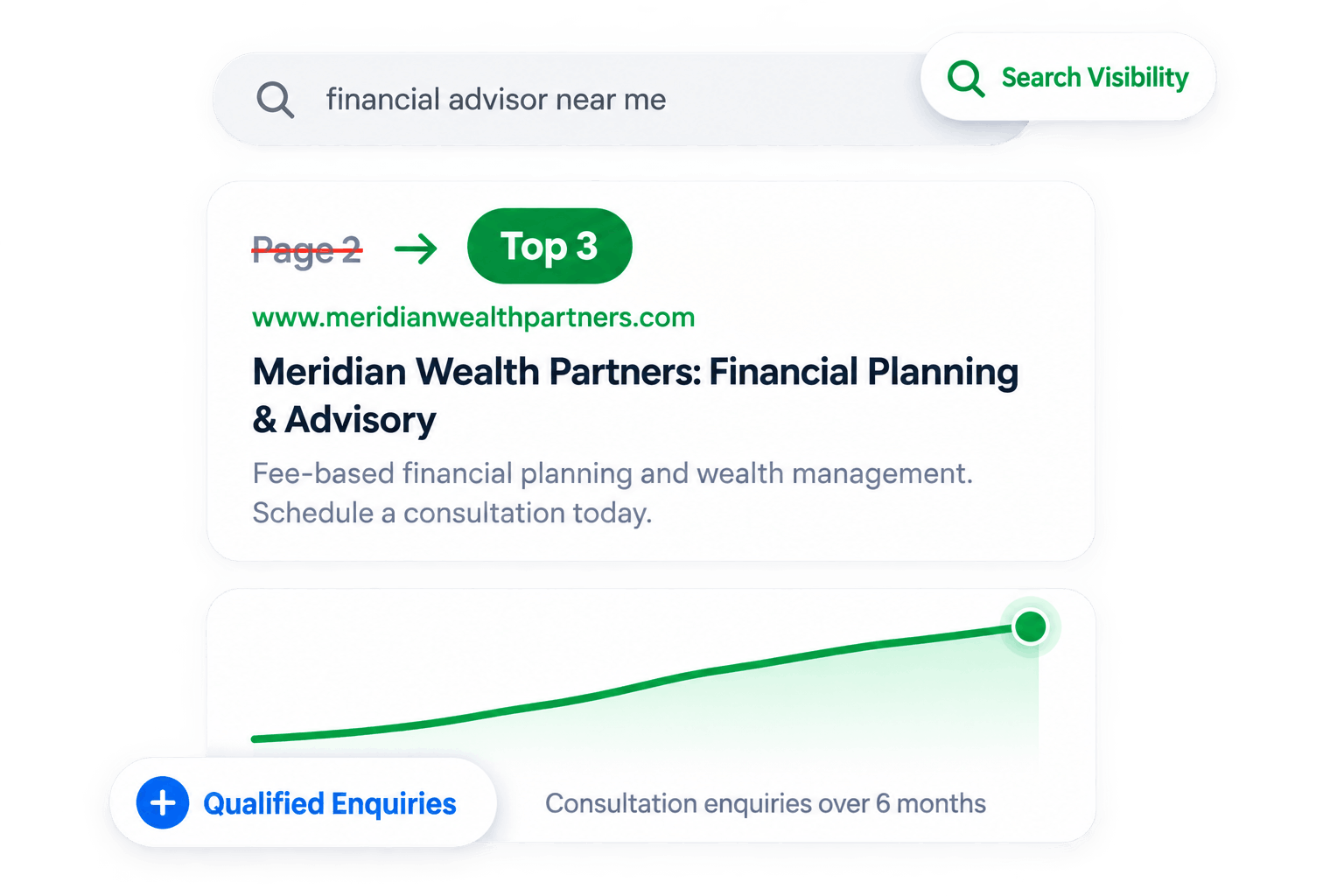
Financial decisions start with a search bar
Before someone calls a financial advisor, applies for a mortgage, or switches accountants, they search. That search happens long before any phone call — and how a business shows up in it shapes whether it gets considered at all.
Someone comparing wealth management firms rarely picks the first name they hear. They search “wealth management firm near me,” open three or four websites, and quietly rule out the ones that look thin, outdated, or vague about what they actually do. The same happens with a small business owner searching “business accountant” after a bad experience with their last one, or a first-time buyer typing “mortgage broker” into Google at 11pm.
Financial keywords are some of the most competitive in any industry. National brands, comparison sites, aggregators and well-funded fintech platforms all compete for the same terms a local advisor or regional firm needs to rank for. Ranking well requires more than a nicely designed website — it requires a site that Google, and the person reading it, can trust.
Trust is not optional in this category. Financial services sit in what search engines treat as “Your Money or Your Life” territory — content that can materially affect someone’s financial wellbeing. That means the standard for a financial services website is higher than it is for, say, a restaurant or a furniture store. Clear credentials, accurate information, transparent service descriptions and a secure, well-maintained website all factor into whether a page earns visibility and whether a visitor converts.
Done properly, organic search becomes a channel that keeps producing enquiries long after a single ad campaign would have stopped. A well-structured service page or a genuinely useful retirement planning guide can keep attracting qualified visitors for years, not weeks.
Local SEO for financial services
Local search matters for almost any financial business that meets clients in person or serves a defined region: financial advisors, accountants, mortgage brokers, and insurance agencies all depend on it. Local SEO covers Google Business Profile, Google Maps, the local pack, citations, NAP consistency, reviews, local backlinks, and location pages.
Google weighs three broad signals for local results: proximity to the searcher, relevance to the search, and prominence, which covers reviews, citations, and overall authority. No single factor guarantees a ranking on its own; it’s the combination that a proper local SEO strategy is built around.
Consistent business information across every directory, genuine local backlinks, and location pages built with real local relevance all contribute to the same outcome: showing up where your future clients are actually searching.

Financial services content strategy
Service pages cover commercial and transactional intent. Educational content covers the research stage before that: financial planning guides, retirement planning education, tax basics, mortgage guides, insurance explainers, investment education, and terminology explainers written for someone new to the topic.
This content answers real questions prospects search before they’re ready to enquire, and it links back to the relevant service page, so the informational article and the commercial page reinforce each other. Content stays educational throughout; readers are pointed toward a qualified professional for advice specific to their own circumstances, since general content can’t account for individual financial situations.

Financial advisor SEO
Financial advisors, financial planners, wealth managers, investment advisors, and retirement planners all compete for search intent that differs from general financial services searches. A prospect searching “retirement planning advisor [city]” wants very different reassurance than one searching “business accountant [city],” even though both are financial decisions.
Advisor-focused content tends to perform best when it addresses specific life stages and financial situations directly: approaching retirement, receiving an inheritance, planning for a child’s education, or managing equity compensation. Credentials matter heavily here too. A clear author page listing relevant qualifications and experience does more for trust than a polished but anonymous “About Us” page ever will.

Google Business Profile optimization
Your Google Business Profile is often the first thing a potential patient sees when they search for a dentist nearby. If the profile is incomplete, outdated, or missing important information, your practice can miss valuable local search opportunities.
We optimize your profile with the right primary and secondary categories, accurate practice information, complete service listings, relevant photos, and regular updates. We also help you manage patient reviews by creating a simple process for requesting, monitoring, and responding to them.
A complete and active profile gives patients the information they need before visiting your website. It also helps Google better understand your dental practice, the services you offer, and the areas you serve, which can support stronger visibility in local search results.
YMYL content and trust
Google treats financial topics as “Your Money or Your Life” content, meaning inaccurate or untrustworthy information can genuinely harm someone. That classification calls for a stronger editorial standard than most other industries.
Qualified authorship
Content attributed to someone with real, relevant expertise, not left anonymous.
Expert review
Financial content reviewed for accuracy before publishing, and revisited as rules or figures change.
Up-to-date information
Tax figures, rates, and regulatory references kept current rather than left stale.
Transparent business information
Clear details about the firm, its services, and how to make contact.
Appropriate disclaimers
Clear statements that content is educational, not individual financial advice.
Secure, well-maintained infrastructure
HTTPS, accurate privacy information, and a site that functions reliably.
E-E-A-T (experience, expertise, authoritativeness, and trustworthiness) isn’t a direct ranking score Google calculates and applies. It’s a framework for producing content that’s genuinely useful and credible, which tends to perform better in search precisely because it’s the kind of content real readers trust. We build every piece of financial content around that framework, and we never present it as a shortcut to a specific ranking position.
Our Financial Services SEO services
Twelve services, one outcome: more of the right prospects finding and contacting your firm. Local SEO, content strategy, and YMYL trust get their own dedicated sections further down this page.
Financial Services Keyword Research
We identify the terms that matter based on search intent, business value, competition, location, the specific services offered, the audience being targeted, and where each keyword sits in the client journey from “what is a fiduciary advisor” at the awareness stage to “fee-only financial planner [city]” at the decision stage.
Competitor SEO Analysis
We map what’s already ranking: competitor keyword coverage, content gaps, backlink sources, local SEO strength, site structure, and how competing firms turn visitors into booked consultations. This tells us where the real opportunities sit, not just where the obvious ones are.
Technical SEO
Crawlability, indexation, Core Web Vitals, page speed, mobile usability, HTTPS, XML sitemaps, robots.txt, canonical tags, duplicate content, broken links and structured data — the infrastructure that determines whether Google can find, understand and rank a site at all.
On-Page SEO
Title tags, meta descriptions, heading structure, internal linking, image optimisation, URL structure, and matching each page to the actual search intent behind the keywords it’s targeting.
Financial Services Content Strategy
Educational guides, detailed service pages, FAQs, comparison content, glossaries of financial terms, and location-specific content — built to answer real client questions and support the pages that generate enquiries.
Local SEO
Google Business Profile optimisation, Google Maps visibility, Local Pack rankings, local citations, review management, NAP consistency, local backlinks and dedicated location pages for firms serving more than one area.
Google Business Profile Optimisation
Accurate categories and services, a clear business description, correct hours and contact details, a linked website, real photos, and a genuine review strategy. We never recommend fake or incentivised reviews.
Service Page SEO
Dedicated, properly optimised pages for financial planning, wealth management, investment management, tax planning, insurance, mortgage services, retirement planning, business financial services, accounting and bookkeeping — built only for services genuinely offered.
Location SEO
Legitimate service-area pages that reflect where a firm actually operates, each with genuine local detail not mass-produced city pages swapping out a single place name.
Link Building
Ethical authority building through professional associations, industry publications, local business organisations, directories, expert commentary and genuine partnerships. No spam networks, no paid link schemes.
Conversion Optimisation
Clear consultation calls-to-action, simplified contact forms, visible phone numbers, credible trust signals, credentials displayed prominently, straightforward navigation and mobile usability so the traffic SEO brings in has the best chance of becoming an actual enquiry.
Where financial services websites lose visibility
These are the issues we see most often when we audit financial services websites — and the real business cost behind each one.
Weak website structure
Services are buried in one long “What We Do” page instead of dedicated pages Google can rank individually.
Poor service pages
Pages describe the firm rather than answering what a prospective client is actually searching for.
Low local visibility
An unclaimed or thin Google Business Profile means the firm is invisible in the Local Pack and Maps.
Thin financial content
Generic, templated blog posts that don’t reflect real expertise or answer real client questions.
Weak author credibility
Financial content published with no named author, credentials, or professional background.
Outdated content
Tax thresholds, rates, or regulatory references left unchanged for years.
Weak backlink profile
Few or no links from credible financial, local, or industry sources.
Benefits of Financial Services SEO
Real business outcomes, not vanity ranking metrics. None of this comes with a guarantee, but it’s what a properly executed strategy is built to produce.
Qualified organic traffic
Visitors already searching for the services you actually offer.
More enquiries
Better visibility converts into more calls and consultation requests over time.
Better search visibility
More of your pages showing up for the searches that matter to your business.
Stronger local presence
Better positioning for the city and region searches your clients actually run.
More profitable service visibility
Dedicated pages capture higher-value services instead of losing them to one generic page.
Improved brand authority
Consistent visibility and credible content build recognition over time.
Long-term acquisition
Rankings keep working after any single campaign ends.
Reduced dependence on paid traffic
Organic visibility lowers how much of your pipeline relies on an active ad budget.
What Financial Services SEO looks like in practice
The figures below are illustrative. They represent a realistic pattern, not a specific verified result from a named SEO Rankster client. Actual results depend on competition, website authority, location, content quality, and implementation.
Initial problem
An independent financial advisory firm ranked only for its own name, had no dedicated service pages, and had almost no educational content addressing common client questions.
Audit & strategy
The audit found weak technical performance, thin service descriptions, and no author credentials attached to any content on the site.
Technical & content work
Technical fixes addressed speed and indexation first. Dedicated pages were built for retirement planning and investment advisory services, each attributed to a named advisor with listed credentials, and a local SEO cleanup improved Google Business Profile accuracy.
Indexed, ranking service pages
Organic traffic
Monthly consultation enquiries via search
0
Baseline
Under 5
8
+2.4x
18+
Potential business impact A steadier pipeline of qualified consultation requests, with less month-to-month reliance on referrals alone. These figures are illustrative of a realistic pattern, not a guarantee, and actual results vary by market and competition.
How long does Financial Services SEO take?
Timelines depend on competition, existing website authority, location, content quality, technical condition, and how quickly changes get implemented. The pattern below is typical, not a fixed promise.
Foundation
Audit findings, technical fixes, and Google Business Profile setup, mostly invisible work everything else depends on.
Structure
Service pages and site structure improvements go live, and early keyword movement typically starts to appear.
Traction
Local visibility and organic traffic usually become clearly noticeable, along with an uptick in enquiries.
Compounding growth
Rankings stabilise for competitive terms, and authority, content, and reviews keep reinforcing each other.
Financial Services SEO FAQ
What is Financial Services SEO?
Financial Services SEO is search engine optimisation built for financial businesses: advisors, wealth managers, accountants, mortgage brokers, and insurance firms among others. It covers technical fixes, service pages, local SEO, and trustworthy content aimed at ranking your business for the searches your prospects run.
Why do financial companies need SEO?
Most people research a financial decision online before contacting anyone. If your firm doesn’t appear in that research, a competitor who ranks better gets the enquiry instead, regardless of who actually offers better service.
How does SEO help financial advisors?
By improving visibility for the specific services and life-stage searches prospects run, and by building the credibility signals, like clear credentials and educational content, that help a prospect trust an advisor enough to reach out.
How long does financial SEO take?
Most businesses see early movement within three to four months, with stronger results building over six to twelve months. Timelines depend on competition and your website’s starting condition.
How much does financial services SEO cost?
It depends on your competition, number of services and locations, and current website condition. We provide a customised quote after an initial assessment rather than a fixed price.
Can SEO help financial advisors rank locally?
Yes, for advisors who work with local clients. Google Business Profile optimisation, citations, and location relevance all factor into local visibility.
Can SEO help wealth management firms?
Yes. Wealth management searches tend to be highly researched, so authoritative, well-credentialed content usually plays an even larger role than for more transactional financial services.
Why is E-E-A-T important for financial websites?
Financial topics fall under Google’s YMYL classification, meaning poor-quality information can genuinely harm someone. E-E-A-T is a framework for producing trustworthy, expert-backed content, not a direct ranking score, but it reflects the standard financial content should meet regardless.
What is the difference between financial SEO and Google Ads?
Ads deliver immediate visibility for as long as you keep paying per click. SEO takes longer to build but keeps generating visibility without an ongoing cost per click once rankings are established.
Find out where your firm actually stands on Google
Most architecture firms have never had a proper look at their search visibility. Not because it doesn’t matter, but because there’s rarely time between projects to check.
A short strategy call gives you a clear picture: what’s working, what’s quietly costing you enquiries, and what it would take to fix it. No pressure, no aggressive sales process.
- +1 (325) 202-3140
- support@seoranksters.com
- Melbourne | New York | Remote Global
- Mon–Fri: 9am–6pm (AEST & EST)
Featured low‑competition cities:
🇦🇺 Perth, Sunshine Coast, Geelong, Hobart, Newcastle, Townsville
🇺🇸 Phoenix, San Antonio, Jacksonville, Columbus, OKC, El Paso
Get exclusive insights for these markets.
Request a free SEO audit
Fill every relevant detail – our experts will reply within 24h.