
Accountants SEO
Attract more local clients, increase your online visibility, and grow your accounting firm with tailored SEO strategies designed specifically for accountants. Reach the people searching for your services and turn more website visitors into enquiries.
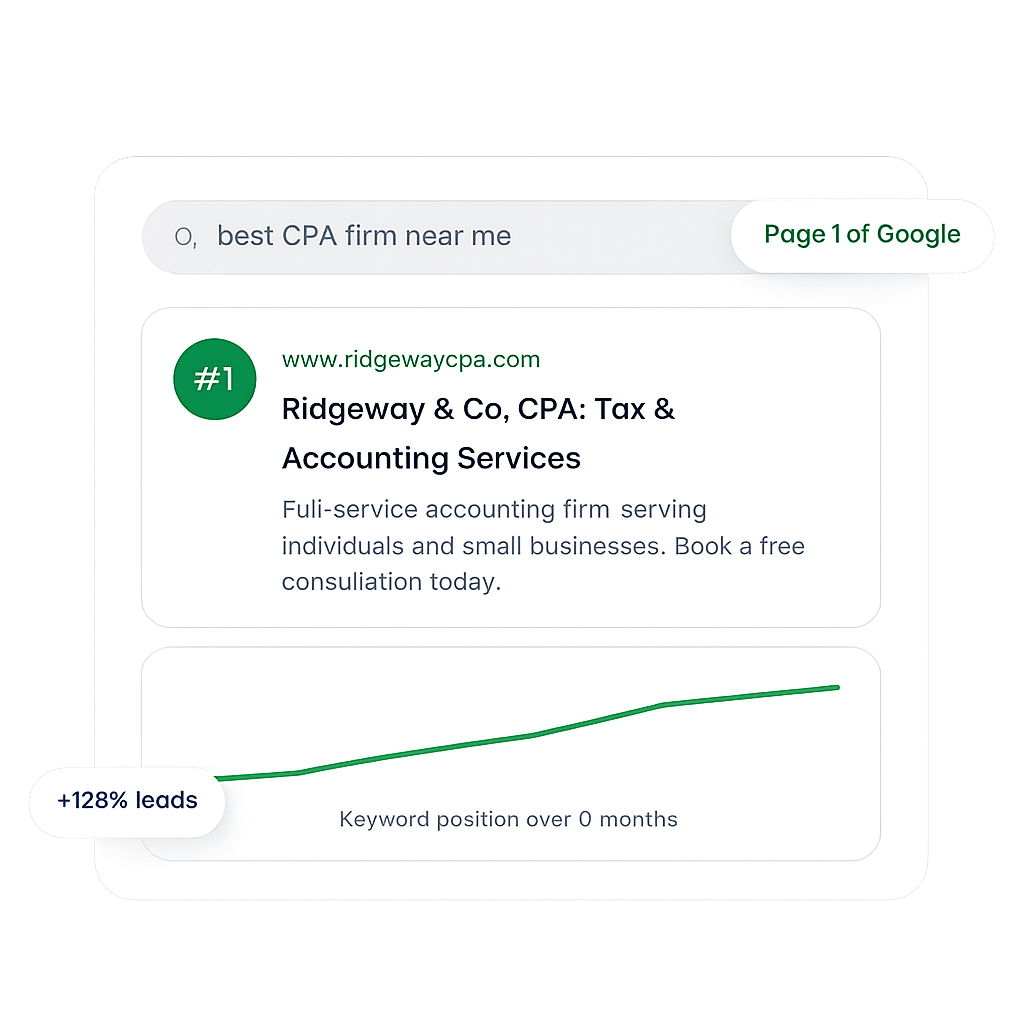
Why accountant SEO can't be an afterthought
Search behavior isn’t a trend. It’s how people already choose an accountant, a bookkeeper, or a tax advisor. These numbers explain why.
of people searching for an accountant never scroll past the first page of Google, which makes that first page the entire competitive arena.
of all Google searches are looking for something local, like “accountant near me” or “tax preparer in [city].”
page-one clicks go to the top organic result, more than the next four listings on the page combined.
is roughly how long it takes most local searchers to call or visit a firm after finding it on their phone.
Your next client is already searching. The question is who they find.
Nobody wakes up and randomly picks an accountant. They search first. A small business owner types “bookkeeper for my LLC,” a new parent types “tax preparer near me,” a startup founder types “CPA for tech companies.” Every one of those searches ends with a shortlist of three or four firms, and that shortlist is built entirely from what Google decides to show.
How people actually search for an accountant
Accounting is a trust purchase. People don’t buy on impulse, they research, compare, and check reviews before they ever pick up the phone. That research happens on Google, on your Google Business Profile, and on the service pages of your website. If your firm doesn’t show up clearly at each of those steps, you’re not in the running, no matter how good your actual work is.
Referrals alone have a ceiling
Referrals are wonderful and they’re also unpredictable. You can’t forecast next quarter’s growth around who happens to mention your name at a dinner party. Accountant SEO turns that unpredictable trickle into a channel you can actually plan around: a steady stream of people who found you, read your content, checked your reviews, and decided to reach out before you said a word to them.
That’s the real difference between SEO and most other marketing a firm tries. Paid ads stop the moment the budget stops. A referral network stops growing the moment you stop actively working it. Search visibility, once it’s built correctly, keeps working in the background every single day.
The competitive landscape has changed
Ten years ago, an accounting firm’s real competition was the two or three other firms in the same zip code. Today it’s also national tax software, online bookkeeping platforms, and marketplace apps that all bid for the exact same search terms your ideal client is typing. A local firm that ignores search visibility isn’t just losing to the CPA down the street anymore, it’s losing shelf space to companies with far bigger marketing budgets and no local presence at all. Ranking well is one of the few ways a smaller firm can compete for attention on equal footing.
What a searcher sees before they ever click your website
Long before someone lands on your homepage, they’ve already formed an opinion. They’ve seen your star rating next to three competitors, skimmed a snippet of your meta description, and maybe noticed whether your Google Business Profile has recent photos and responses to reviews. All of that happens on the search results page itself, before a single click. Accountant SEO isn’t only about the website, it’s about controlling that entire first impression, from the map pack listing down to the words used in your page title.
Keyword research is where the real strategy starts
Before we write a single page, we map out the actual language your prospective clients use. That’s rarely the language a firm uses internally. A firm might describe a service as “outsourced controller services,” while the searcher types “someone to manage my books and give me monthly reports.” Matching that gap between internal terminology and real search behavior is often the single biggest lever in the entire strategy, and it’s a step that gets skipped far more often than it should.
Solo practitioners and multi-partner firms search differently too
A solo tax preparer usually competes on responsiveness and personal attention, so their content and profile should lean into that: fast response times, direct access to the person doing the work, a personable author bio. A multi-partner firm with specialized departments competes more on depth and range of expertise, so its site needs distinct pages for each specialty with named partners behind each one. Applying the same template to both misses what actually makes each type of firm appealing to the person searching for it.
The SEO problems we find on almost every accounting website
Before we fix anything, we run a full audit. These are the issues that show up again and again.
Thin, generic service pages
A single “Services” page listing bookkeeping, payroll, and tax prep together tells Google nothing specific, so it ranks for nothing specific either. Each service needs its own page built around the exact phrases a client would use to search for it.
Unclaimed or inconsistent Google Business Profile
Wrong hours, missing categories, or a profile that was never verified quietly removes a firm from the local map pack entirely, often without the owner ever realizing it happened.
Slow page speed
Bloated themes, oversized images, and unused plugins push load times past the point where mobile visitors simply leave, which tells Google the page delivers a poor experience.
No schema markup
Without structured data, Google has to guess what your firm does and where it operates instead of being told directly through code it can read instantly.
Inconsistent NAP across the web
A different phone number on Yelp than on the website confuses local ranking signals and erodes the trust directories and Google both place in the listing.
Missing author credentials
Content with no named CPA, no license number, and no bio gives Google little reason to treat the firm as an authority on the topic it’s writing about.
Keyword cannibalization between pages
Two different pages quietly competing for the same search term split ranking signals instead of combining them, so neither page performs as well as one clear page would.
No internal linking strategy
Pages sitting in isolation, with no links connecting a blog post about tax deadlines to the tax preparation service page, waste an easy opportunity to guide visitors toward a call.
Individually, any one of these issues might only cost a firm a handful of rankings. Together, they compound, and that’s usually why a firm with genuinely excellent client work still shows up on page two or three of Google. Fixing them in the right order is the entire point of the audit we run before any other work begins.
What changes when accountant SEO is done right
This isn’t about vanity rankings. It’s about what those rankings actually produce for the firm.
A lead flow that doesn't depend on referrals
New inquiries arrive from people who found you on their own, on top of whatever your existing referral network already brings in, which gives the whole firm a second, independent growth channel.
A lower cost per lead over time
Paid ads cost roughly the same on day one and day five hundred. Organic rankings get cheaper per lead the longer they’re maintained, since the same page keeps attracting new visitors without a fresh spend behind every click.
Higher-intent, better-fit clients
People who read your content and reviews before calling arrive already trusting your expertise, which shortens the sales conversation and cuts down on tire-kicking inquiries that never go anywhere.
Visibility that works around the clock
A well-optimized service page answers a prospect’s question at 11pm on a Sunday just as well as it does on a Tuesday afternoon, capturing interest at the exact moment someone decides to act.
Ownership instead of renting attention
Rankings live on property you control. Unlike a directory listing or ad account, this asset keeps compounding in value with every month of work, and it stays yours even if you ever change agencies.
Scales cleanly across locations
Adding a second office is a matter of building a location page and citation set the right way, not starting a marketing plan from zero, so growth stays manageable instead of chaotic.
A better client relationship from day one
Someone who found your firm through a helpful article they read on their own tends to arrive more receptive and easier to work with than a cold lead chasing the cheapest quote.
Accountant SEO services built around one goal: qualified inquiries
Every service below feeds the same outcome: more of the right people finding your firm on Google. Nothing on this list exists just to pad a proposal, and most engagements combine several of these rather than a single isolated tactic
Technical SEO audits & fixes
We check crawlability, indexing, site architecture, and Core Web Vitals, then fix what’s actually blocking Google from ranking the site fairly. This is always the first place we look, since content and links can’t compensate for a technically broken site
On-page SEO & service pages
Dedicated pages for tax preparation, bookkeeping, payroll, and advisory services, each written for one search intent instead of everything at once, with titles, headers, and internal links built around it.
Local SEO & Google Business Profile
Profile optimization, category selection, citation building, and NAP cleanup so the firm shows up in the map pack for its service area, plus an ongoing plan for gathering genuine client reviews.
Content marketing for accounting topics
Articles that answer the tax, bookkeeping, and financial questions your ideal clients are already typing into Google, written with real expertise and credited to a named professional at your firm.
Link building & digital PR
Earning links from relevant, reputable sites rather than buying low-quality placements that put the domain at risk, through genuine outreach and content worth linking to in the first place.
Website performance & Core Web Vitals
Faster load times, cleaner code, and a mobile experience that keeps visitors on the page instead of bouncing back to the results, measured against Google’s own performance benchmarks.
Conversion rate optimization
Traffic only matters if it converts. We test calls to action, contact forms, and page layout so visits turn into booked consultations rather than quiet exits
Reporting & analytics
Clear monthly reporting through Google Search Console and Google Analytics 4, tied to rankings, traffic, and actual leads, not vanity metrics that look good but don’t explain anything.
How we build topical authority through content
Ranking for “accountant near me” is only part of the picture. The firms that dominate search results over time usually rank for dozens, sometimes hundreds, of related questions, and that comes from a deliberate content structure rather than a random string of blog posts.
We organize content around pillar topics your ideal clients actually search for: tax filing deadlines and extensions, choosing between an LLC and an S-corp, bookkeeping software comparisons, payroll compliance basics, and industry-specific guidance for verticals like real estate agents, e-commerce sellers, and independent contractors who all have different accounting needs. Each cluster links back to the relevant service page, and the service pages link out to the supporting articles, so the whole site reinforces itself instead of existing as a scattered collection of unrelated posts.
This structure also happens to be exactly what search engines are built to reward. A cluster of interlinked pages, each covering one specific angle of a broader topic in real depth, signals topical authority far more clearly than the same amount of content spread thin across unrelated one-off posts.
Local SEO for accountants: winning the map pack
When someone searches “accountant near me,” Google usually shows three map pack listings above every organic result. If your firm isn’t one of the three, you’re effectively invisible for that search, no matter how strong the website is underneath.
What goes into ranking in the Google Map Pack
- A fully claimed and verified Google Business Profile with the correct categories
- Consistent name, address, and phone number across every directory (NAP consistency)
- A steady flow of genuine client reviews with thoughtful responses
- Location pages for each office if the firm serves more than one city
- Proximity and relevance signals tied to the searcher's actual location
- Local citations from directories relevant to accounting and professional services
Where accountant-specific citations actually come from
Beyond the general business directories, accounting firms have their own set of relevant citation sources: state CPA society directories, the Better Business Bureau, Bing Places, Apple Business Connect, and local chamber of commerce listings. Getting listed consistently across these, with matching name, address, and phone number, builds the kind of local trust signal a generic citation strategy usually misses entirely.
The citation mistake we see most often
Firms that have moved offices, changed phone systems, or rebranded slightly often end up with three or four slightly different versions of their business information scattered across the web: an old suite number here, a dropped middle initial in the firm name there. Each inconsistency chips away at the confidence Google places in the listing. Cleaning this up is unglamorous work, but it’s consistently one of the higher-impact fixes in a local SEO audit.

Reviews are a ranking signal and a trust signal at the same time
Review count, review recency, and star rating all factor into how Google ranks a local listing, but reviews do double duty because they also shape whether a prospect actually picks up the phone once they’ve found you. A firm with 4 reviews from three years ago reads very differently than one with 60 recent reviews and thoughtful responses to the occasional critical one. We build a simple system for asking satisfied clients for a review at the right moment, usually right after a return is filed or a project wraps up, rather than leaving it to chance.
How we build EEAT into accounting content specifically
Google’s own guidance points at experience, expertise, authoritativeness, and trust as signals that separate genuinely useful content from content written just to rank. For an accounting firm, that translates into concrete practices rather than an abstract concept
- Every article is attributed to a named professional with their title and, where relevant, their license or certification
- Author bio pages link back to credentials and years of experience at the firm
- Content referencing tax law or filing rules links out to primary sources like IRS.gov or the relevant state agency
- Older articles get revisited and updated when tax law or filing deadlines change, rather than left to go stale
None of this is complicated, but it does require discipline that’s easy to skip when content gets treated as a checkbox rather than a real asset. A site with ten outdated, unattributed articles usually performs worse than a site with three well-credentialed, current ones, which is why we’d rather build the library slowly and correctly than flood it with volume.
The Google ranking factors that actually move accountant SEO results
Google uses hundreds of signals, but for a professional services website like an accounting firm’s, these are the ones that consistently make the difference. Understanding them is also what separates a strategy built on real priorities from one built on guesswork.
Experience, expertise, authority, trust
Named authors with real credentials, licensing details, and years of experience signal to Google that the content can be trusted, especially in a regulated field like accounting.
Core Web Vitals & page speed
Loading speed, visual stability, and responsiveness directly affect both rankings and how long a visitor stays on the page.
Mobile-friendliness
Google indexes and ranks based primarily on the mobile version of a site, so a clunky mobile experience caps rankings across the board.
Backlink profile & domain authority
Links from relevant, reputable sites still function as one of the strongest trust signals a website can accumulate.
Content relevance & depth
Pages that thoroughly answer a specific question outperform thin pages that vaguely mention many topics at once.
On-page optimization
Title tags, header hierarchy, internal linking, and schema markup help Google understand exactly what each page is about.
Local relevance signals
Google Business Profile activity, citations, and reviews weigh heavily for any search with local intent, which most accounting searches have.
User experience & engagement
How long visitors stay, whether they click back to the results, and how they navigate the site all feed back into rankings over time.
Site security & HTTPS
A valid SSL certificate is table stakes at this point, but a firm handling sensitive financial information has extra reason to get this right.
Internal linking structure
How pages link to each other tells Google which pages matter most and helps visitors move naturally from a blog post to a service page.
None of these factors work in isolation. A fast, secure site with weak content still won’t rank, and brilliant content on a slow, poorly linked site won’t either. The strategy has to address all of them together, weighted by how much each one actually matters for your specific market.
What accountant SEO looks like in practice
This composite example reflects the pattern we typically see across accounting firm engagements, from starting point to results.
The challenge
A three-partner CPA firm ranked on page three for “CPA near me” and had no visibility in the local map pack. Their website hadn’t been touched in four years, loaded in over seven seconds on mobile, and offered a single vague services page covering every offering at once.
The strategy
We rebuilt the technical foundation, split one generic services page into five targeted service pages, cleaned up citations across 40+ directories, and published a monthly content series answering real client tax questions, each one credited to one of the partners.
The result
Within eight months, the firm’s core keywords moved from page three to the top three organic positions, and the Google Business Profile began appearing consistently in the local map pack for its service area, with reviews climbing steadily throughout the engagement.
average position, core keyword
increase in qualified form submissions
organic traffic over 8 months
THE TAKEAWAY None of this came from a single trick. It came from fixing the technical foundation first, then giving Google clear, specific pages and consistent local signals to rank. That order matters more than any individual tactic on its own.
A realistic SEO timeline for an accounting firm
Anyone promising first-page rankings in two weeks is either exaggerating or targeting keywords nobody searches for. Here’s what actually happens.
Foundation
Technical fixes, Google Business Profile setup, citation cleanup, and the first wave of rebuilt service pages go live. This stage rarely produces dramatic ranking jumps, but it’s what everything after it depends on.
Momentum
Content publishing ramps up, early keyword movement appears in tracking, and local visibility starts to firm up as citations and reviews accumulate.
Traction
Target keywords typically reach page one, organic traffic climbs noticeably, and inquiry volume starts to reflect it in a way that’s visible in the monthly reporting.
Compounding growth
Rankings stabilize near the top, the content library keeps attracting new searches on its own, and link authority keeps building on itself with less active push required.
Timelines shift depending on how competitive your market is and how much work the existing site needs. A firm in a smaller city with light local competition often moves faster than one competing in a dense metro area against a dozen established practices.
Accountant SEO myths worth retiring
A lot of firms hesitate on SEO because of outdated advice they picked up years ago. Here’s what’s actually true today.
SEO is a one-time project you finish and forget.
Google’s algorithm and your competitors both keep moving. Rankings need ongoing maintenance, the same way a well-kept client relationship needs regular attention rather than a single initial meeting
Stuffing a page with the keyword "accountant" more times will help it rank.
Modern search understands meaning and context, not just repetition. Overusing a keyword can actively hurt a page’s ranking and makes the writing harder to read for actual visitors.
A handful of directory listings is enough local SEO.
Directories help, but Google Business Profile optimization, a steady flow of reviews, and citation consistency across the web all matter just as much as the listings themselves.
Any general marketing agency can handle accountant SEO.
Accounting has its own search intent, compliance considerations, and trust signals that a generalist strategy built for restaurants or retail usually misses entirely.
Rankings are the only thing that matters.
Rankings are the vehicle. Qualified traffic that converts into booked consultations is the actual goal, and both numbers need to be measured together, not ranking position alone.
A bigger website with more pages will automatically outrank a smaller one.
Page count means nothing on its own. A smaller site with focused, well-structured pages regularly outranks a bloated one padded with thin, low-value content.
Accountant SEO frequently asked questions
What is accountant SEO?
Accountant SEO is search engine optimization built specifically for accounting, bookkeeping, and tax professionals. It covers technical fixes, local SEO, content, and link building, all aimed at ranking your firm for the searches people run when they need an accountant, like “CPA near me” or “small business bookkeeper.” General SEO tactics can help, but the strategy works best when it accounts for how trust-driven and license-sensitive the accounting industry actually is.
How long does SEO take to work for an accounting firm?
Most firms start seeing measurable movement in rankings and traffic within three to four months, with noticeable lead growth by month five or six. Full compounding results typically build over seven to twelve months. Anyone claiming first-page rankings within days or weeks is either describing paid ads or targeting keywords with almost no competition and little search volume.
How much does SEO cost for an accounting firm?
Pricing depends on the current state of the website, the number of locations, and how competitive the target keywords are. A single-location firm with a reasonably healthy site typically needs less investment than a multi-location practice competing in a dense metro market. We provide a specific quote after the initial audit rather than a generic number that doesn’t reflect your actual starting point.
What's the difference between SEO and PPC for accountants?
Do I need a blog for accountant SEO to work?
How important is Google Business Profile for accountants?
Extremely important. Most local searches for an accountant trigger Google’s map pack, which shows three business listings before any organic result. If your profile isn’t claimed, verified, and fully optimized with the right categories and consistent information, you’re likely missing that visibility entirely, regardless of how strong your website is. It’s often the single highest-impact fix for a firm that hasn’t touched its listing in years.
Can SEO work for a single-location CPA firm?
Yes, and in some ways it’s simpler than a multi-location strategy. A single-location firm can focus entirely on one Google Business Profile, one set of local citations, and content built around one service area, without the added complexity of separating signals between multiple offices. That focus often means faster results than a comparable multi-location campaign.
SEO Services by Industry
Let's find out what accountant SEO could do for your firm
Send over your firm’s details and current website. We’ll run a free audit and walk you through exactly what’s holding your rankings back and what it would take to fix it. No canned report generated by a tool, an actual person on our team looks at your site, your Google Business Profile, and the keywords your ideal client is already searching for.
If accountant SEO isn’t the right fit for where your firm is right now, we’ll tell you that directly instead of pushing a proposal anyway. Firms that reach out tend to fall into one of two groups: ready to start immediately, or gathering information before deciding on a plan for next quarter. Either is a fine reason to have this conversation.
- +1 (325) 202-3140
- support@seoranksters.com
- Melbourne | New York | Remote Global
- Mon–Fri: 9am–6pm (AEST & EST)
Featured low‑competition cities:
🇦🇺 Perth, Sunshine Coast, Geelong, Hobart, Newcastle, Townsville
🇺🇸 Phoenix, San Antonio, Jacksonville, Columbus, OKC, El Paso
Get exclusive insights for these markets.
Request a free SEO audit
Fill every relevant detail – our experts will reply within 24h.