
Architect SEO that turns Google searches into project enquiries
Most architecture websites are built to look impressive, not to get found. SEO Rankster builds Architect SEO strategies that fix that: technical fixes, service pages, portfolio optimisation, and local visibility, so the firms searching for an architect like yours actually find you first.
Built for architecture practices specifically residential, commercial, landscape, and interior architecture firms, not adapted from a generic small business template.
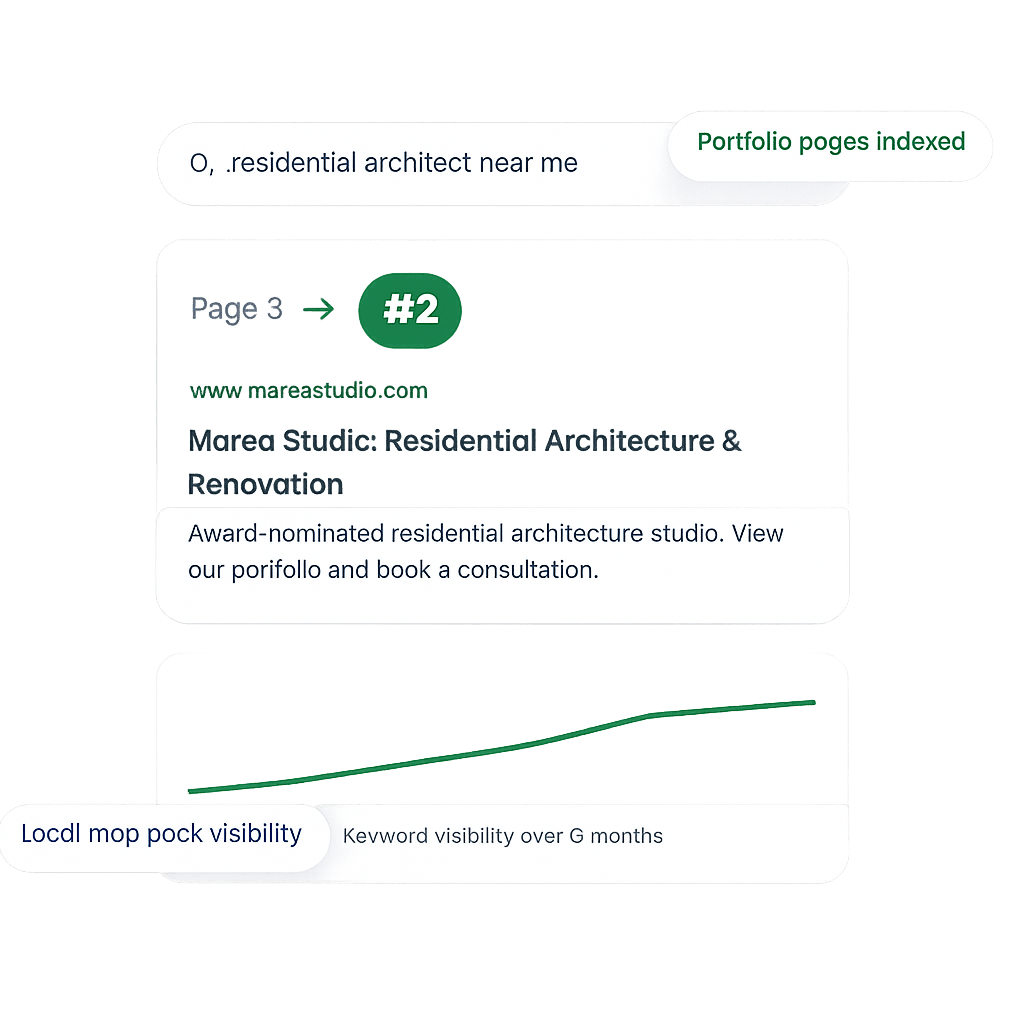
Why Architect SEO matters for a firm like yours
Clients research before they call
Someone planning a home extension or a commercial fit-out doesn’t pick an architect at random. They search, look through a few portfolios, check reviews, and shortlist two or three firms before reaching out. If your firm doesn’t appear in that search, you’re not on the shortlist, regardless of the quality of your work.
Architecture is a local search category
Most architecture searches include a location, whether that’s a specific city or simply the intent behind “architect near me.” A firm that ranks well locally competes for enquiries that a firm with no local SEO strategy never sees.
A portfolio only helps if it's visible
Architecture firms invest heavily in photographing and presenting finished projects. That investment is wasted if the portfolio exists purely as images, with no text content for Google to read, understand, and rank.
High-value projects need online authority
A client considering a six-figure renovation or a commercial development does more research than someone booking a haircut. They read project descriptions, check credentials, and look for evidence of relevant experience. A website with real authority signals moves that decision in your favour before the first phone call.
Paid advertising can put your firm in front of some of these searches, but only while the budget is active. Organic search, once built properly, keeps generating enquiries long after the work that built it is finished, which is what makes it a genuine long-term acquisition channel rather than a recurring expense.
Architecture portfolio SEO
A portfolio built purely as an image gallery is a missed opportunity. Search engines can’t interpret a beautiful photograph on their own; they need text, structure, and context around it to understand what the project is and who it’s relevant to.
Every project page should include a clear description of the brief, the location, the project type, the services provided, the design challenge, and the outcome. That’s not filler copy. It’s the exact information a prospective client searching for “architect for a period property extension” is looking for, and it’s what gives Google a reason to rank the page for that search.
Image optimisation matters just as much. Compressed file sizes, descriptive filenames, and specific alt text (not “IMG_2481”) all help both page speed and search visibility. Each project page should also link to related services and related location pages, so a strong project reinforces the pages around it instead of sitting in isolation.

Local SEO for architects
Local SEO covers Google Business Profile optimisation, accurate map listings, and local keyword targeting for the cities and regions your firm actually works in. It also includes location pages, since a firm serving three or four areas needs more than a single homepage to compete for searches in each one.
Local citations and consistent NAP details (name, address, phone number) across directories build the trust signals Google uses for local rankings. Genuine client reviews add to that, and so do local backlinks from relevant sources: industry bodies, local press, or planning and property publications.
None of this replaces good work. It simply makes sure the firms already doing good work in a given area are the ones showing up when someone searches for it.

Content strategy for architects
Service pages and project pages cover commercial and transactional search intent. Content covers the informational searches that come before them: renovation guides, planning application basics, sustainable design articles, cost-related education, and local architecture guides specific to your area.
This content does two things. It answers real questions a prospective client is likely searching before they’re ready to contact anyone, and it builds the kind of topical depth that signals genuine expertise rather than a firm that only publishes when it needs new work.
Project case studies belong here too. A well-written case study, covering the brief, the constraints, and the outcome, works as both content and portfolio evidence at the same time.
Technical SEO for architecture websites
Architecture websites carry a technical challenge most industries don’t: large, high-resolution photography on nearly every page. Uncompressed images are one of the most common reasons an otherwise well-designed site fails Core Web Vitals and loses rankings to a faster, less polished competitor.
We handle image compression, mobile optimisation, crawlability, and indexation, along with the less visible fundamentals: a clean XML sitemap, a correctly configured robots.txt file, canonical URLs, structured data, HTTPS, and a URL structure that makes sense to both visitors and search engines. We also check for broken links, which accumulate quickly on sites with dozens of project pages added over the years.
None of this is visible to a client browsing your portfolio. All of it determines whether that client ever finds the portfolio in the first place.

Architect SEO pricing
Pricing depends on your actual situation, not a fixed package. We quote after understanding what your project involves.
Competition
A firm competing in a dense metro market needs more work than one in a smaller region with fewer rivals.
Target locations
One office versus several service areas changes the scope of local SEO required.
Number of services
A firm offering residential, commercial, and interior work needs more service pages than a single-focus practice.
Website size and condition
A large site with years of technical debt costs more to fix than a smaller, newer one.
Content requirements
How much new content needs writing depends on what already exists and how competitive the topics are.
Technical complexity
Custom-built or heavily animated sites often need more technical work than standard CMS platforms.
Link acquisition
Building authority from close to zero takes more sustained effort than strengthening an existing profile.
Number of locations
Each additional office or service area adds its own local SEO workload.
SEO ranking factors for architects
Google weighs hundreds of signals. For an architecture website, these consistently matter most.
Relevant, specific content
Pages that directly answer a search perform better than pages that vaguely mention many things.
Search intent match
A page needs to match what the searcher actually wants, whether that’s information or a firm to contact.
Local relevance
Location signals matter heavily, since most architecture searches carry local intent.
Website quality & page experience
Speed, stability, and mobile usability all factor directly into rankings.
Technical SEO health
Crawlability and indexation determine whether Google can even evaluate a page in the first place.
Authority & backlinks
Links from relevant, reputable sources remain one of the strongest trust signals available.
Reviews
Review volume and rating influence both local rankings and a prospective client’s first impression.
Internal linking & structured data
Clear site structure and schema markup help Google understand exactly what each page offers.
What Architect SEO looks like in practice
The figures below are illustrative. They represent the kind of pattern we typically aim for, not a specific verified result from a named SEO Rankster client.
Starting problem
A boutique residential architecture studio had a visually strong portfolio site with almost no indexed text content. Service pages were generic, and the firm had no visibility for any city-specific searches beyond its own name.
Strategy
Technical fixes addressed image compression and crawlability first. Service pages were rebuilt around residential project types, and each portfolio project was restructured with real descriptive content, location context, and internal links.
Local SEO & content
Google Business Profile was fully optimised, citations cleaned up, and a content series addressing renovation and planning questions began publishing monthly.
Indexed, ranking pages
Organic traffic
Project enquiries via search
Under 10
Baseline
Rare
45+
+2.8x
Consistent, monthly
Business impact The firm went from relying almost entirely on referrals to fielding a steady, if modest, stream of enquiries that mentioned finding the studio through Google. These numbers are illustrative of a realistic outcome, not a guaranteed or verified result.
Architect SEO timeline
Results depend on competition, existing website authority, location, content quality, and how many technical issues need fixing first. The pattern below is typical, not guaranteed.
Foundation
Audit findings, technical fixes, and Google Business Profile setup, mostly invisible work that everything else depends on.
Structure
Service pages, project pages, and location pages get rebuilt, and the first content begins publishing.
Early movement
Early keyword and traffic movement typically becomes visible, along with improved local visibility.
Compounding growth
Rankings stabilise for competitive terms, and the content library keeps attracting new searches on its own.
Architect SEO frequently asked questions
What is Architect SEO?
Architect SEO is search engine optimisation built specifically for architecture firms. It covers technical fixes, service pages, portfolio optimisation, local SEO, and content, aimed at ranking your practice for the searches prospective clients run when looking for an architect.
How much does SEO for architects cost?
It depends on your competition, number of locations, website condition, and how many services you offer. We provide a specific quote after an initial audit rather than a fixed package price.
How long does Architect SEO take?
Most firms see early movement within three to four months, with meaningful traffic and enquiry growth building over the following six to twelve months. Timelines vary based on competition and your site’s starting condition.
How do architects rank locally on Google?
Local rankings depend on a fully optimised Google Business Profile, consistent business information across directories, genuine reviews, and location-specific pages for each area you serve.
Do I need a Google Business Profile if I don't have a public office?
Usually yes, though the setup differs for service-area businesses without a walk-in location. Google allows you to hide your exact address while still listing the areas you serve.
Can SEO help with high-value or commercial projects, not just residential?
Yes. Commercial and property development clients research online too, often more thoroughly. The strategy and content simply target different search terms and a different kind of authority signal than residential searches.
What's the difference between SEO and paid ads for architects?
Paid ads deliver visibility immediately but stop the moment you stop paying. SEO takes longer to build but keeps generating visibility without an ongoing cost per click once rankings are established.
SEO Services by Industry
Find out where your firm actually stands on Google
Most architecture firms have never had a proper look at their search visibility. Not because it doesn’t matter, but because there’s rarely time between projects to check.
A short strategy call gives you a clear picture: what’s working, what’s quietly costing you enquiries, and what it would take to fix it. No pressure, no aggressive sales process.
- +1 (325) 202-3140
- support@seoranksters.com
- Melbourne | New York | Remote Global
- Mon–Fri: 9am–6pm (AEST & EST)
Featured low‑competition cities:
🇦🇺 Perth, Sunshine Coast, Geelong, Hobart, Newcastle, Townsville
🇺🇸 Phoenix, San Antonio, Jacksonville, Columbus, OKC, El Paso
Get exclusive insights for these markets.
Request a free SEO audit
Fill every relevant detail – our experts will reply within 24h.