
Physio SEO that gets your clinic found and booked
SEO Rankster helps physiotherapy clinics rank higher for the searches that actually lead to booked appointments: injury searches, condition searches, sports physio searches, and the local “near me” searches that decide who gets the call.
Built around how patients actually search for physiotherapy, not a generic local business template with the word “physio” dropped in.
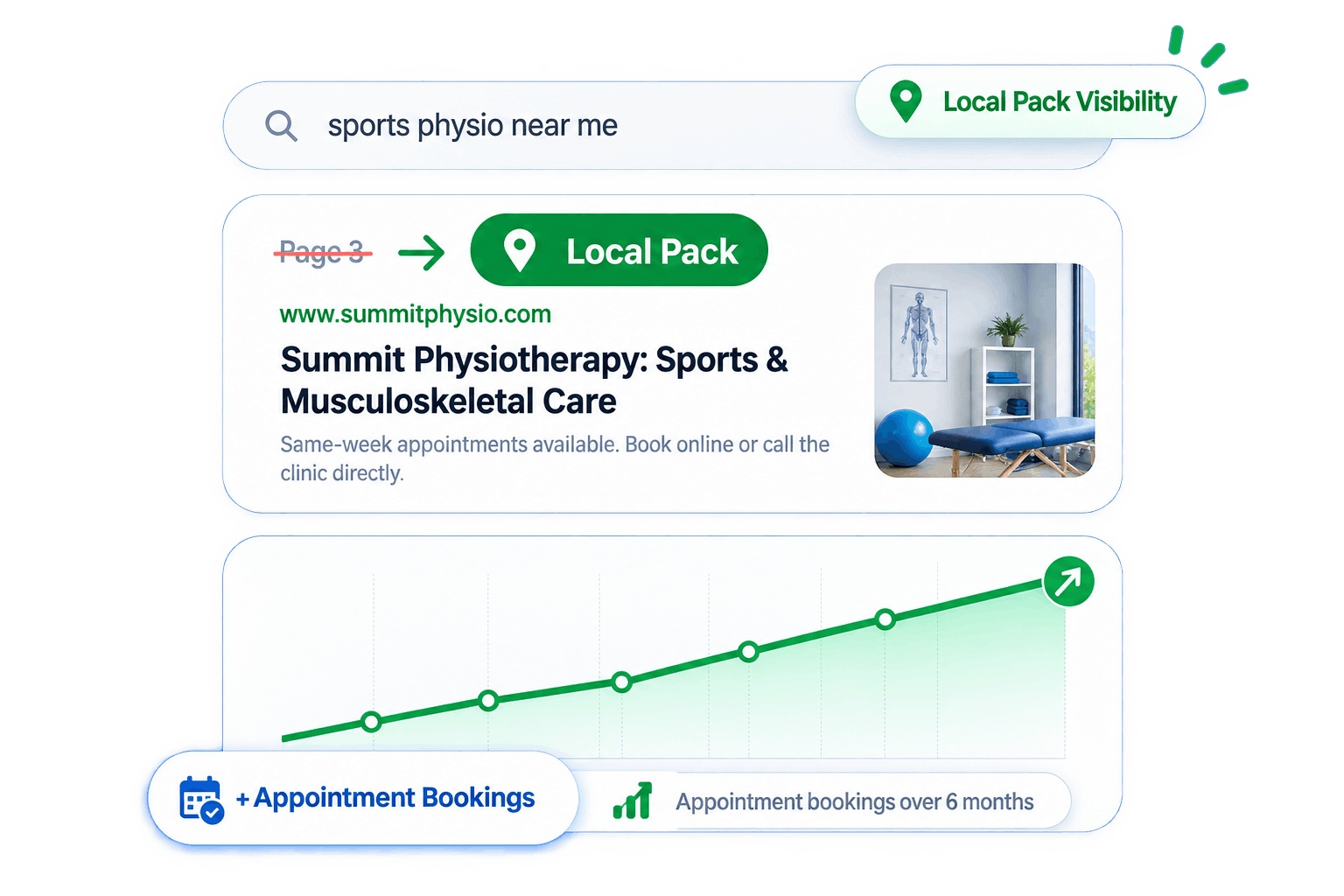
Why Physio SEO matters
Physiotherapy sits in a genuinely good position for organic search, better than many industries, because the patient is already looking for exactly what a clinic offers.
Patients are already looking for help
Nobody searches “back pain physio” out of curiosity. This is high-intent traffic from people actively trying to solve a physical problem.
Almost every search has local intent
“Physiotherapist near me” and “physio clinic [city]” reflect the same underlying need: someone who wants care close to where they live or work.
Conditions and sports create repeat search patterns
A runner searching “ACL rehabilitation” today may search “return to running after injury” in six weeks. Content built around a condition keeps working across that whole recovery arc.
Reputation carries real weight
Physiotherapy involves ongoing, hands-on sessions. Patients check reviews and credentials more carefully than they would for a one-off purchase.
Ranking for a handful of the right searches, sports injury searches for a sports clinic, women’s health searches for a pelvic health specialist, matters more than ranking broadly for irrelevant traffic. A clinic that shows up for “what to do about a torn calf muscle” and “sports physio near me” together is capturing a patient at two different, connected points in the same decision.
Physio SEO services
Nine areas of work, all aimed at the same result: the patients already searching for physiotherapy find your clinic instead of the one next door.
Keyword Research for Physiotherapists
“Physiotherapist near me,” “what does physiotherapy do for back pain,” and “sports physiotherapy [city]” represent three different intents from three different points in the patient journey. We select keywords based on patient intent, the services you actually offer, conditions treated, location, search demand, competition, and where each term sits in the booking funnel, not just search volume.
Competitor SEO Analysis
We study competitor ranking keywords, service and treatment pages, location pages, Google Business Profiles, reviews, backlinks, and conversion paths. A gap in a competitor’s content or local presence is usually an opportunity your clinic can take instead.
Technical SEO
Crawlability, indexation, site speed, Core Web Vitals, mobile usability, broken links, XML sitemap, robots.txt, canonicals, duplicate content, HTTPS, structured data, and image optimisation, tuned for the reality of physiotherapy sites: treatment photos, multiple locations, and practitioner profiles that can quietly create duplicate content if left unmanaged.
On-Page SEO
Title tags, meta descriptions, heading structure, treatment and service content, internal linking, URLs, images, and alt text, optimised around real search intent without making the writing read like it was built for a search engine instead of a patient.
Physiotherapy Content Strategy
Content built around the conditions, treatments, sports injuries, and rehabilitation questions your patients actually search, connected back to the commercial service pages it supports. Covered in more depth further down this page.
Local SEO
Google Business Profile, Google Maps, citations, NAP consistency, and reviews. Covered in more depth further down this page.
Google Business Profile Optimisation
Accurate categories, a complete service list, a clear business description, correct contact details and hours, current photos, a website link, and an appointment link where your booking system supports one. We never recommend fake reviews or stuffing keywords into your business name.
Physiotherapist Profile SEO
Individual practitioner pages covering qualifications, areas of practice, experience, specialties, professional memberships, treatment interests, and clinic affiliation. We build these from the credentials you provide; we never invent or embellish them.
Treatment and Condition Page SEO
Dedicated pages for the services you genuinely offer, whether that’s back pain physiotherapy, sports physiotherapy, shoulder or knee physiotherapy, or post-operative rehabilitation. We build pages for real services, not a long list of thin pages created purely to chase keywords.
Local SEO for physiotherapists
“Physiotherapist near me” and “physio near me” are not the same kind of search as “what is physiotherapy.” They carry immediate local intent from someone who wants an appointment close to home or work, and they’re decided largely by the Google Maps local pack that sits above most organic results.
Local visibility rests on Google Business Profile completeness, consistent name, address, and phone details across every directory, genuine patient reviews, local backlinks, and location pages that reflect a real, staffed clinic rather than a placeholder built to claim more territory. None of these factors alone decides a ranking. Together, they build the local relevance Google’s systems are designed to reward.
What we won’t do: create fake clinic locations, publish incentivized reviews, build doorway pages, stuff keywords into a business name, or mass-produce near-identical city pages. Those tactics tend to get flagged, and the damage to a clinic’s credibility usually outlasts whatever short-term visibility they bought.

Google Maps and Physio SEO
For a “physio near me” search, Google Maps often decides the shortlist before a patient ever visits a website. Business categories that match your actual services, an accurate list of treatments, current photos of the clinic, and genuine reviews all shape whether you make that shortlist.
Website relevance matters here too. A Maps listing connected to a site with clear, specific service pages reinforces the same signals Google is already evaluating. Local authority, built through citations and local backlinks, adds to it over time.
We won’t claim we can guarantee a specific Maps position; nobody outside Google can promise that honestly. What we can do is address every factor within reach and track the impact clearly.

Real Physio SEO problems clinics run into
Most physiotherapy websites we review share a familiar set of issues. Each one has a knock-on effect on patients, and on visibility, that’s worth understanding before it gets fixed.
Weak Google Business Profile
Missing service categories and outdated hours push a clinic down the local pack, exactly where “physio near me” searches get decided.
Generic service pages
One page listing every treatment in a paragraph gives a patient searching for sports physio no reason to think this clinic specializes in it.
Thin condition pages
A vague page on “back pain” that never mentions causes, red flags, or what treatment involves doesn’t answer what the patient actually searched.
No physiotherapist profile pages
Patients researching credentials before booking find nothing to check, which quietly pushes them toward a competitor who’s easier to vet.
Duplicate location content
Near-identical pages for each clinic site confuse both patients trying to pick the right branch and Google trying to rank either one.
Inconsistent NAP details
A different phone number on a directory than on the website erodes the local trust signals Google Maps rankings depend on.
Slow, image-heavy pages
Clinic photos and treatment galleries left uncompressed slow load times, and a patient in pain has little patience for it.
No patient education content
A site with only a homepage and contact page has no way to rank for the “what does physiotherapy do for X” searches that start most patient journeys.
Weak appointment paths
Visitors who land on the site but can’t find a phone number or booking link quickly are visibility gains that never convert into patients.
Physio content and healthcare trust
Physiotherapy content sits under Google’s YMYL umbrella, the same category covering medical and financial topics where poor information carries real consequences. That calls for a different editorial standard than a typical business blog.
Qualified authorship
Content attributed to a real physiotherapist, not left anonymous.
Practitioner review
Clinical content checked by someone qualified to verify it before it publishes.
Evidence-based references
Claims about conditions or treatment grounded in accepted clinical understanding, not guesswork.
Visible update dates
A signal that guidance has been revisited, not left to go stale for years.
Clear, plain language
Accurate explanations that don’t require a medical degree to follow.
Honest disclaimers
Content that’s upfront about what it can’t do: replace an actual assessment.
E-E-A-T (experience, expertise, authoritativeness, and trustworthiness) isn’t a score Google calculates and applies directly to a page. It’s a framework for producing content that’s genuinely credible, which tends to perform better precisely because it’s the kind of content patients and search engines both have reason to trust. We write and structure physiotherapy content to meet that standard, and every piece is educational rather than a substitute for an actual consultation. Patients with an individual concern are always pointed toward booking an assessment rather than self-diagnosing from an article.
How We Build Topical Authority Through Content
Ranking a physiotherapy practice for “physio near me” is only one part of a successful SEO strategy. To attract consistent organic traffic, your website needs to be relevant to the wider range of services, treatments, conditions, and locations your potential patients are searching for.
We build content strategies around the searches that matter to your practice. This can include pages targeting services such as sports physiotherapy, musculoskeletal physiotherapy, injury rehabilitation, post-surgery rehabilitation, exercise therapy, and other treatments you provide. We also develop useful content around common conditions such as back pain, knee pain, shoulder pain, neck pain, and sports injuries where these topics align with your services.
Location-based content is another important part of the strategy for practices targeting local patients. We can build relevant location and service pages that help your website appear for searches such as “physiotherapist in [location],” “sports physio in [location],” and other location-specific searches that have a clear connection to your services.
We then connect these pages through a logical internal linking structure. Supporting content links to relevant service pages, service pages connect with related treatments, and location pages are connected where appropriate. This helps visitors find the information they need while giving search engines a clearer understanding of your website and the services your practice offers.
The result is a website that can compete for a broader range of relevant searches rather than relying on a single keyword. By building useful topical coverage around your physiotherapy services, we help create more opportunities for your practice to attract relevant organic traffic and generate inquiries from people actively looking for physiotherapy services.
How We Build E-E-A-T Into Physio SEO Content
When people search for a physiotherapy practice, they want to know that the information they find is accurate and that the professionals behind the practice are qualified to provide care. That’s why trust and credibility are important considerations when we create SEO content for physiotherapy websites.
We create content around your actual services and areas of expertise rather than producing generic articles simply to target keywords. Treatment pages and educational content are written to provide useful information while accurately representing the services your practice provides. Where appropriate, we use reliable healthcare sources to support important claims and help maintain the credibility of the content.
Your practitioners also play an important role in establishing trust. We make it easy for potential patients to learn about the physiotherapists behind your practice, including their qualifications, experience, areas of expertise, and professional background. These details can help visitors feel more confident when deciding whether your practice is right for them.
We also review important content over time. Healthcare information and treatment recommendations can change, and outdated information can reduce the usefulness of a page. Keeping key content accurate and relevant helps your website continue to provide a better experience for visitors.
Our approach is not about publishing hundreds of generic blog posts. We focus on creating useful, accurate content that supports your services, answers relevant patient questions, demonstrates the expertise within your practice, and gives search engines stronger signals about the quality and relevance of your website.
Google Business Profile Optimisation
For a physiotherapy practice targeting local patients, your Google Business Profile can be one of the most important parts of your local SEO strategy. It can appear in Google Maps and local search results when people search for terms such as “physio near me,” “physiotherapist in [location],” or specific physiotherapy services in their area.
We optimise your profile to accurately represent your practice and the services you offer. This includes selecting relevant primary and secondary categories, completing your business information, adding appropriate services, improving your business description, and keeping photos and other profile information up to date.
Reviews are another important part of your local presence. We help you establish a consistent process for encouraging genuine patients to leave reviews and for responding professionally to feedback. Regular, authentic reviews can strengthen your credibility with potential patients and contribute to a stronger local search presence.
We also monitor your Google Business Profile for opportunities to keep it accurate and useful. As your services, opening hours, location details, or other business information change, we make sure your profile reflects those updates.
A well-optimised profile gives potential patients accurate information when they are actively looking for a physiotherapy practice. Combined with your website, local SEO, and review strategy, it helps your practice build stronger visibility in Google Maps and local search results.
What Physio SEO looks like in practice
The figures below are illustrative. They describe a realistic pattern, not a specific verified result from a named SEO Rankster client. Real outcomes vary by specialty, location, competition, and how thoroughly the work gets implemented.
Starting situation
A sports-focused physiotherapy clinic ranked only for its own name, had one shared services page covering everything from sports injuries to post-surgical rehab, and no content addressing common running or gym injuries.
Keyword & local SEO problems
The Google Business Profile listed a generic “physiotherapist” category with no specific services, and citations across directories used two different phone numbers.
Strategy & work done
A dedicated sports physiotherapy service page was built alongside a content cluster covering running injuries, ACL rehabilitation, and return-to-sport guidance. The Google Business Profile was corrected and fully optimised, and citations were cleaned up across 30+ directories.
Local pack visibility for “sports physio near me”
Organic traffic
Monthly appointment enquiries via search
none
Baseline
Baseline
Under 10
Consistent
+3.1x
30+
Consistent
Potential business impact A steadier flow of sports injury patients specifically, rather than a mix of unrelated enquiries, the clinic wasn’t set up to convert as easily. These figures are illustrative of a realistic pattern, not a promised result.
Physio SEO FAQ
What is Physio SEO?
Physio SEO is search engine optimisation built around how patients actually search for physiotherapy: condition searches, treatment searches, sports injury searches, and local “near me” searches. It covers technical fixes, service and condition pages, local SEO, and content held to a healthcare-appropriate standard.
Why do physiotherapists need SEO?
How does SEO help a physiotherapy clinic?
By improving visibility for the specific conditions, treatments, and locations patients search, and by making sure the website gives a visitor enough reason to trust the clinic and book.
How can I get my physiotherapy clinic to appear on Google?
Start with a complete, accurate Google Business Profile and dedicated pages for your actual services and conditions treated. Technical health and consistent business information across directories matter just as much as the content itself.
How can physiotherapists rank on Google Maps?
Accurate categories, a complete service list, genuine reviews, current photos, and consistent business information all factor into map pack visibility, alongside the relevance of the website behind the listing.
What keywords should a physiotherapist target?
A mix of local terms like “physio near me,” condition and treatment terms like “back pain physiotherapy” or “sports physiotherapy,” and the informational questions patients search before they’re ready to book, prioritised by which searches your clinic can genuinely serve.
What is local SEO for physiotherapists?
Local SEO covers everything that determines whether your clinic appears for nearby searches: Google Business Profile, Google Maps, citations, NAP consistency, reviews, and location relevance.
How long does Physio SEO take?
Most clinics see early movement within three to four months, with stronger results building over six to twelve months. Timelines depend on competition and the site’s starting condition.
How much does Physio SEO cost?
It depends on clinic size, number of locations and specialties, competition, and current website condition. We provide a customised quote after an assessment rather than a fixed price.
Get more patients to find your physiotherapy clinic
We’ll review your current rankings, local visibility, Google Maps presence, competitor performance, website structure, treatment pages, content opportunities, technical SEO, and conversion paths, then walk you through exactly what we find.
- +1 (325) 202-3140
- support@seoranksters.com
- Melbourne | New York | Remote Global
- Mon–Fri: 9am–6pm (AEST & EST)
Featured low‑competition cities:
🇦🇺 Perth, Sunshine Coast, Geelong, Hobart, Newcastle, Townsville
🇺🇸 Phoenix, San Antonio, Jacksonville, Columbus, OKC, El Paso
Get exclusive insights for these markets.
Request a free SEO audit
Fill every relevant detail – our experts will reply within 24h.