
Dental SEO that helps the right patients find your practice before they find your competitor.
SEO Ranksters helps dental practices improve Google rankings, increase local search visibility, and attract more qualified patients through effective dental SEO strategies.
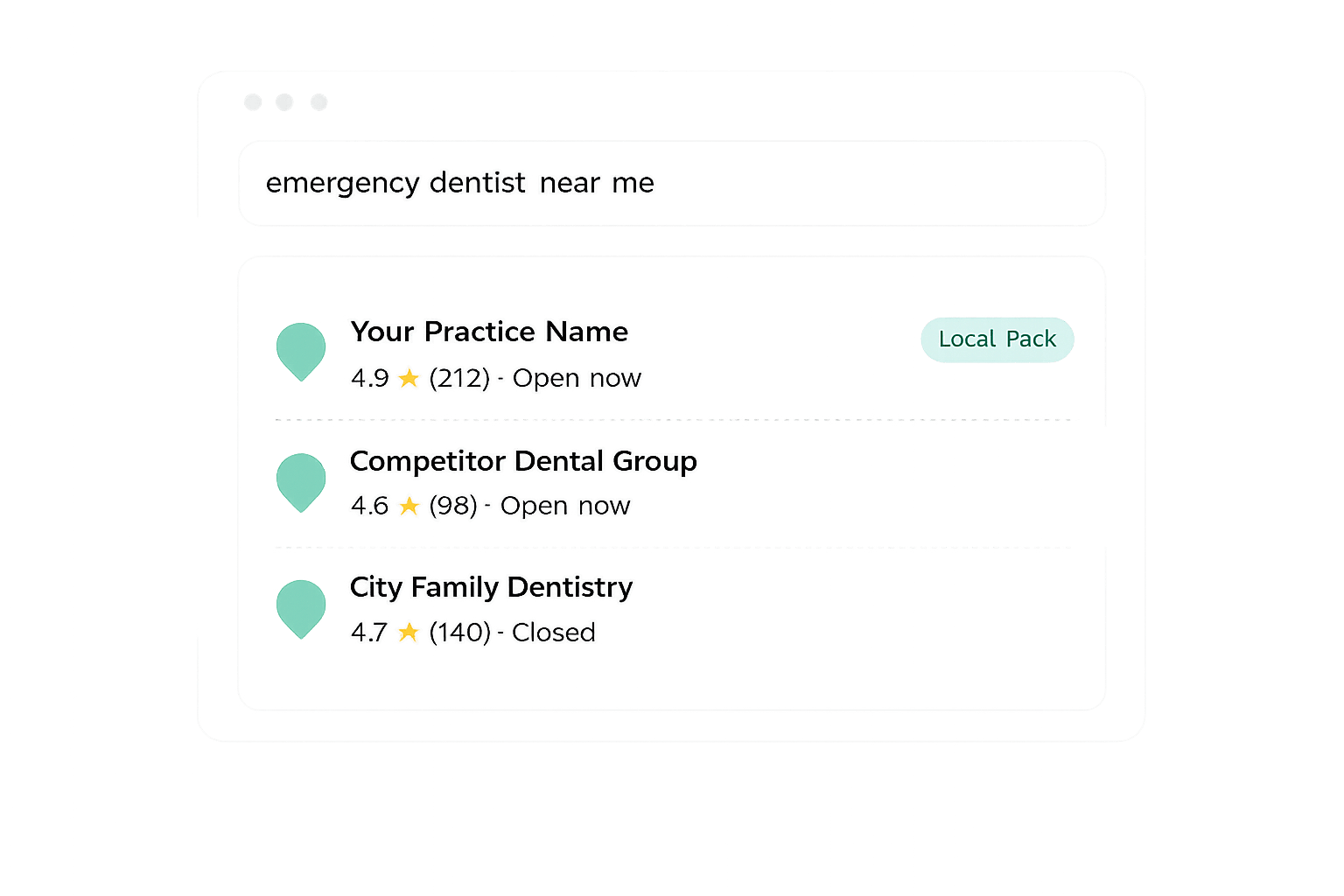
A website is not a marketing plan. Visibility is.
Most dental practices already have a website. Very few of them show up consistently when someone in their area searches for a dentist, a specific treatment, or an emergency appointment. That gap between having a website and being found is where dental SEO does its work.
Patients rarely browse. They search with intent: a symptom, a treatment, a location, or a phrase like “dentist accepting new patients.” Google decides which few practices appear in the local map pack and the organic results, and that decision is shaped by hundreds of local SEO and technical SEO factors your team is not expected to track day to day.
Reviews, mobile experience, page speed, and the depth of your treatment content all feed into how Google evaluates relevance and trust for healthcare-related searches. A practice that ignores these signals is effectively invisible to the patients who are actively looking, right now, for exactly what it offers.

Local SEO for dentists
Local SEO focuses on Google Business Profile optimisation, accurate map listings, and local keyword targeting for the areas your dental practice serves. It also includes location pages, especially for practices serving multiple suburbs, cities, or clinic locations, giving each area a better chance of ranking for relevant dental searches.
Consistent NAP details, including your practice name, address, and phone number, across trusted directories help strengthen local search signals. Genuine patient reviews also play an important role, while relevant local backlinks from healthcare organisations, community publications, dental associations, and local businesses can further support your authority.
None of this replaces quality dental care. It makes sure that when people in your area search for a dentist, dental treatment, or emergency dental care, your practice has a stronger chance of being found.

Content strategy for dentists
Treatment pages and service pages target commercial and transactional searches, while helpful content covers the informational searches patients make before booking an appointment. This can include guides about dental implants, teeth whitening, root canals, emergency dentistry, oral health, treatment costs, and common dental concerns.
This content does two things. It answers the questions potential patients are already searching for and builds topical depth around the treatments and services your practice provides. Consistent, useful content also helps demonstrate expertise and gives patients more reasons to trust your practice before they contact you.
Patient-focused case studies and treatment pages belong here too. A well-written case study can explain the patient’s concern, the treatment provided, and the outcome, giving you useful search content while showing potential patients the type of care your practice delivers.

Local search runs on three things proximity, relevance, and prominence
Google’s local ranking systems weigh how close your practice is to the searcher, how relevant your profile and website are to what they searched, and how prominent your practice is based on signals like reviews, citations, and links. No single factor guarantees a position; they work together.
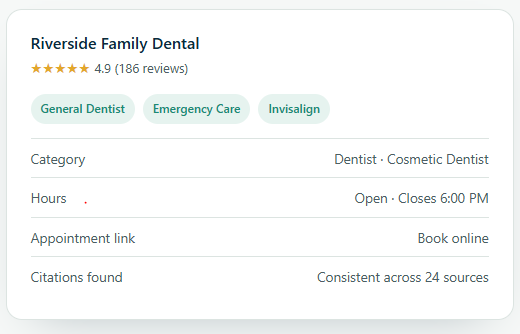
Proximity is largely outside your control, but relevance and prominence are not. A complete, accurately categorised Google Business Profile, consistent business information across the web, and a website that clearly describes your services all strengthen relevance. Genuine reviews, local citations, and legitimate local backlinks build prominence over time.
Consistency matters more than most practices expect. If your practice name, address, or phone number differs across your website, Google Business Profile, and directory listings, that inconsistency can quietly undermine local rankings even when everything else looks fine.
Practical outcomes from dental SEO
We don’t promise specific Google rankings or guarantee a certain number of new patients. Instead, our dental SEO services focus on improving search visibility, attracting more qualified patients, and building sustainable growth for your dental practice. With consistent SEO work, you can expect improvements in:
More qualified traffic
Visitors who are actively searching for the treatments you offer, not passing browsers.
Stronger Google Maps presence
A more complete, consistent profile improves your chances of local pack visibility.
Stronger local reputation
A healthy, current review profile supports both patient trust and local search performance.
A long-term acquisition channel
Unlike paid ads, organic visibility continues to work once it’s built and maintained.
More appointment enquiries
Better-matched traffic and clearer conversion paths tend to lift call and form volume over time.
Higher organic visibility
Ranking for a wider set of relevant treatment and local terms, not just your practice name.
Improved website experience
Faster, clearer, mobile-friendly pages that are easier for patients to act on.
Reduced reliance on paid ads
Not a replacement for advertising, but a way to lower dependence on it over time.
Every part of the strategy, built around how patients actually search
Below is what’s included in a typical dental SEO engagement. Not every practice needs every service on day one; your plan is scoped around your current website, treatments, and locations.
Dental Keyword Research
We build a keyword list around search intent rather than search volume alone. A term with fewer monthly searches but clear treatment intent, such as “same day crown [city],” can be more valuable than a broad, high-volume term with no commercial signal.
- Treatment value: which procedures actually generate revenue for your practice
- Location relevance: the suburbs, towns, or service areas you genuinely serve
- Competition: realistic assessment of what you can compete for now versus later
- Patient relevance: matching language patients actually use, not just clinical terms
- Business priorities: weighting keywords around the services you want to grow
Technical SEO
Technical SEO makes sure Google can actually crawl, understand, and index your site properly. If this layer is broken, nothing else in the strategy performs as it should.
- Crawlability and indexation checks, including XML sitemap and robots.txt review
- Page speed and Core Web Vitals improvements
- Mobile performance, since most dental searches happen on a phone
- HTTPS, canonical URL, and duplicate content cleanup
- Broken link detection and repair
On-Page SEO
Every page gets structured around a single clear search intent, with title tags, meta descriptions, and headings that reflect what the patient is actually looking for.
- Title tags and meta descriptions written for click-through, not stuffed with keywords
- Logical H1/H2 structure that mirrors patient questions
- Internal links connecting related treatments, locations, and guides
- Optimised image file names, alt text, and compressed file sizes
- Clean, descriptive URLs
Dental Treatment Page SEO
High-value treatments deserve their own page, not a shared paragraph on a general services list. This applies to procedures such as dental implants, veneers, teeth whitening, root canal treatment, crowns, bridges, orthodontics, clear aligners, emergency dentistry, wisdom teeth removal, and pediatric dentistry.
Pages are only built for treatments a practice genuinely offers. Creating pages for services you don’t provide misleads patients and creates a poor experience once they arrive.
Local SEO
Local SEO governs whether your practice appears when someone nearby searches for a dentist. It combines your Google Business Profile, citation consistency, reviews, and location-relevant content into one coordinated local presence.
- Google Business Profile setup and ongoing optimisation
- Local citation building and NAP consistency across directories
- Location-relevant content for each area you genuinely serve
- Local backlink opportunities from community and industry sources
Google Business Profile Optimisation
Your Google Business Profile is often the first impression a searching patient gets. We keep it accurate and complete: correct primary and secondary categories, an up-to-date service list, a clear business description, current photos, accurate opening hours, and a working appointment or booking link.
We do not recommend fake reviews or manipulating your review profile in any way. Genuine reviews, requested consistently and ethically, are the only approach we use.
Dental Content Strategy
Content supports treatment pages by answering the questions patients have before they book: what a procedure involves, what recovery looks like, and how one treatment compares to another.
- Treatment guides and procedure explanations written in plain language
- Aftercare information and patient preparation guides
- Dental FAQs addressing common patient concerns
- Treatment comparisons, such as veneers versus whitening
- Preventive and oral health education content
All content is written for general education. It is not a substitute for a clinical consultation, and pages consistently encourage readers to speak with a qualified dentist about their individual situation.
Link Building
We build authority through relevant, legitimate sources: local business organisations, professional dental associations, healthcare directories, community partnerships, and relevant local publications. We do not buy spam links or use link networks, which can carry real risk for a healthcare website’s credibility and rankings.
Review and Reputation SEO
Reviews influence both patient trust and local search visibility. We help set up a consistent, ethical process for requesting reviews from real patients, monitor your reputation across platforms, and support timely responses to reviews, positive or negative.
Conversion Optimisation
Traffic only matters if it turns into enquiries. We review how easily a visitor can call, message, or book once they land on a page.
- Click-to-call buttons and visible phone numbers on mobile
- Simple, short appointment request forms
- Clear calls to action on every treatment and location page
- Trust signals: credentials, reviews, and accurate opening hours placed where they’re needed
Improving your visibility in the map pack
The three-listing local pack often gets more attention than the organic results below it. Improving your position there is less about any single trick and more about the accumulated accuracy and relevance of your profile.
Accurate business information
Correct address, phone number, and service area, matched exactly across your website and every directory listing.
Relevant categories and services
A primary category that matches how patients search, with secondary categories and a complete services list.
Reviews, not review volume alone
Recency, response rate, and content of reviews all matter. Volume alone does not determine map rankings.
Current, real photos
Genuine images of your practice, team, and treatment rooms, kept current as your practice changes.
Website relevance
A website that clearly supports the services listed on your profile strengthens the connection Google draws between the two.
Legitimate local authority
Citations and local backlinks that reinforce your practice as a genuine, established local business.
What a dental SEO engagement can look like
This is a composite, illustrative scenario built to show how the process fits together. It does not represent a specific SEO Rankster client or guaranteed outcome.
Initial situation
A two-dentist general practice ranked only for its own name, with no dedicated treatment pages and an incomplete Google Business Profile.
SEO problems identified
Thin content, slow mobile load times, inconsistent citations, and no clear path from a treatment page to a booked appointment.
Technical work
Image compression, sitemap cleanup, and mobile speed improvements addressed first, since they underpinned everything else.
Treatment page strategy
Dedicated pages built for implants, whitening, and emergency dentistry, the three highest-intent services offered.
Local SEO
Google Business Profile fully optimised, citations corrected across 20+ directories.
Content and authority
Monthly educational content published, linked from each treatment page, alongside outreach to two local health directories.
Measurement
Rankings, organic traffic, and call/form enquiries tracked monthly through Search Console and call tracking.
Potential business impact
Over time, this type of work can lead to broader keyword rankings and steadier enquiry volume, though actual results depend heavily on location, competition, and execution.
Results vary by practice, location, competitive landscape, website starting point, and how consistently the strategy is implemented. No specific outcome is guaranteed.
A realistic timeline, not a countdown
SEO timelines vary based on your website’s starting condition, local competition, and how quickly changes are implemented. This is a general guide, not a fixed promise.
Foundation
Audit, technical fixes, keyword research, and Google Business Profile optimisation.
Structure
Treatment page builds, on-page improvements, and early local SEO work begin to take effect.
Early movement
Rankings for less competitive terms often start moving; content and authority building continue.
Compounding growth
More competitive keywords and sustained local pack visibility typically take shape over this period.
Questions we hear most from practice owners
What is Dental SEO?
Dental SEO is the practice of improving a dental website’s visibility in organic Google search and Google Maps, so more of the right patients find your practice when they search for a dentist or treatment.
Why do dentists need SEO?
Most patients start their search on Google. Without SEO, your practice may be invisible to searchers who don’t already know your name, even if your team and service quality are excellent.
How does SEO help dental practices get new patients?
SEO improves how often your practice appears for relevant local and treatment searches, and how likely a visitor is to call or book once they land on your site.
How long does Dental SEO take?
Early technical and local improvements can show movement within a few months. Competitive treatment and location terms typically take six to twelve months of sustained work.
How much does Dental SEO cost?
Cost depends on your location, competition, website condition, and number of treatments and locations. We provide a customised quote after a free audit.
Can SEO help a dentist rank on Google Maps?
Yes. Google Business Profile optimisation, citation consistency, and genuine reviews all contribute to local pack visibility, though no agency can guarantee a specific position.
What is the difference between Dental SEO and Google Ads?
SEO builds organic visibility that compounds over time; Google Ads buys immediate, paid placement that stops when spend stops. Many practices use both.
Build search visibility that builds trust.
We’ll audit your current website, identify keyword opportunities, evaluate your competitors, assess technical issues, and build a strategy around your services, locations, and business objectives, not a generic package.
- +1 (325) 202-3140
- support@seoranksters.com
- Melbourne | New York | Remote Global
- Mon–Fri: 9am–6pm (AEST & EST)
Featured low‑competition cities:
🇦🇺 Perth, Sunshine Coast, Geelong, Hobart, Newcastle, Townsville
🇺🇸 Phoenix, San Antonio, Jacksonville, Columbus, OKC, El Paso
Get exclusive insights for these markets.
Request a free SEO audit
Fill every relevant detail – our experts will reply within 24h.