
Turn Organic Search Into a B2B Growth Channel
B2B buyers spend months researching before they ever talk to sales. They compare vendors, read guides, check pricing, and search for alternatives long before filling out a form. SEO Rankster builds the search presence that meets buyers at each stage, so your pages earn visits that turn into qualified pipeline.
No ranking guarantees. No keyword stuffing. No mass-produced pages.
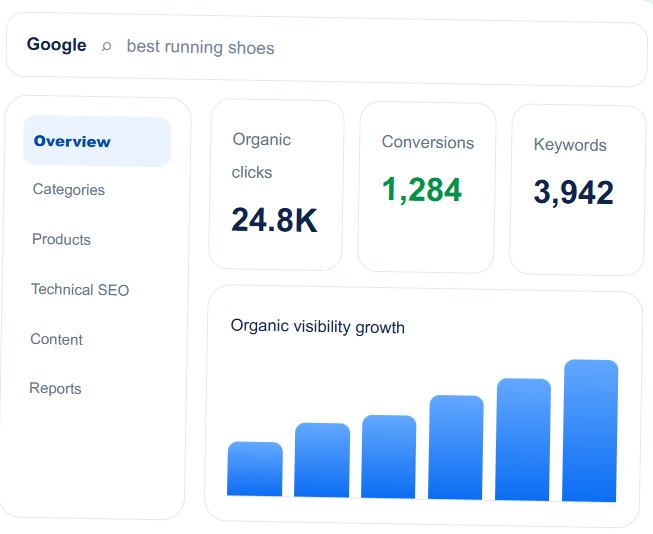
Your Next Customer Is Already Searching
Before a single sales conversation happens, most B2B buyers have already searched for the problem they’re trying to solve, the type of solution that fixes it, specific products or services, potential vendors, comparisons between providers, alternatives to what they currently use, pricing, and what implementation actually involves.
Most B2B websites aren’t built to appear anywhere in that research. They’re built to rank for the company name, and sometimes for a broad industry term that’s too competitive and too generic to convert. A logistics company optimising for “logistics” is competing with every logistics company in the country for a term that says almost nothing about what a specific buyer needs. The searches that actually lead somewhere are more specific, and they happen long before anyone visits the homepage directly.
That gap between what buyers search for and what a website is actually built to rank for is the opportunity. It isn’t about generating more traffic. It’s about being present at the exact moments research is happening, with pages built to answer what’s actually being asked.
Why B2B Search Behaves Differently
A consumer decision might take ten minutes and one person. A B2B decision to switch maintenance software, replace a supplier, or bring in a new consulting partner can take three to eighteen months and involve a plant manager, a procurement lead, an IT director, and someone signing off on budget. Each of them searches differently, at different points, often without talking to each other until later in the process. For software companies, this makes a focused SaaS SEO especially important because buyers often compare features, use cases, integrations, pricing, and alternatives before speaking with sales.
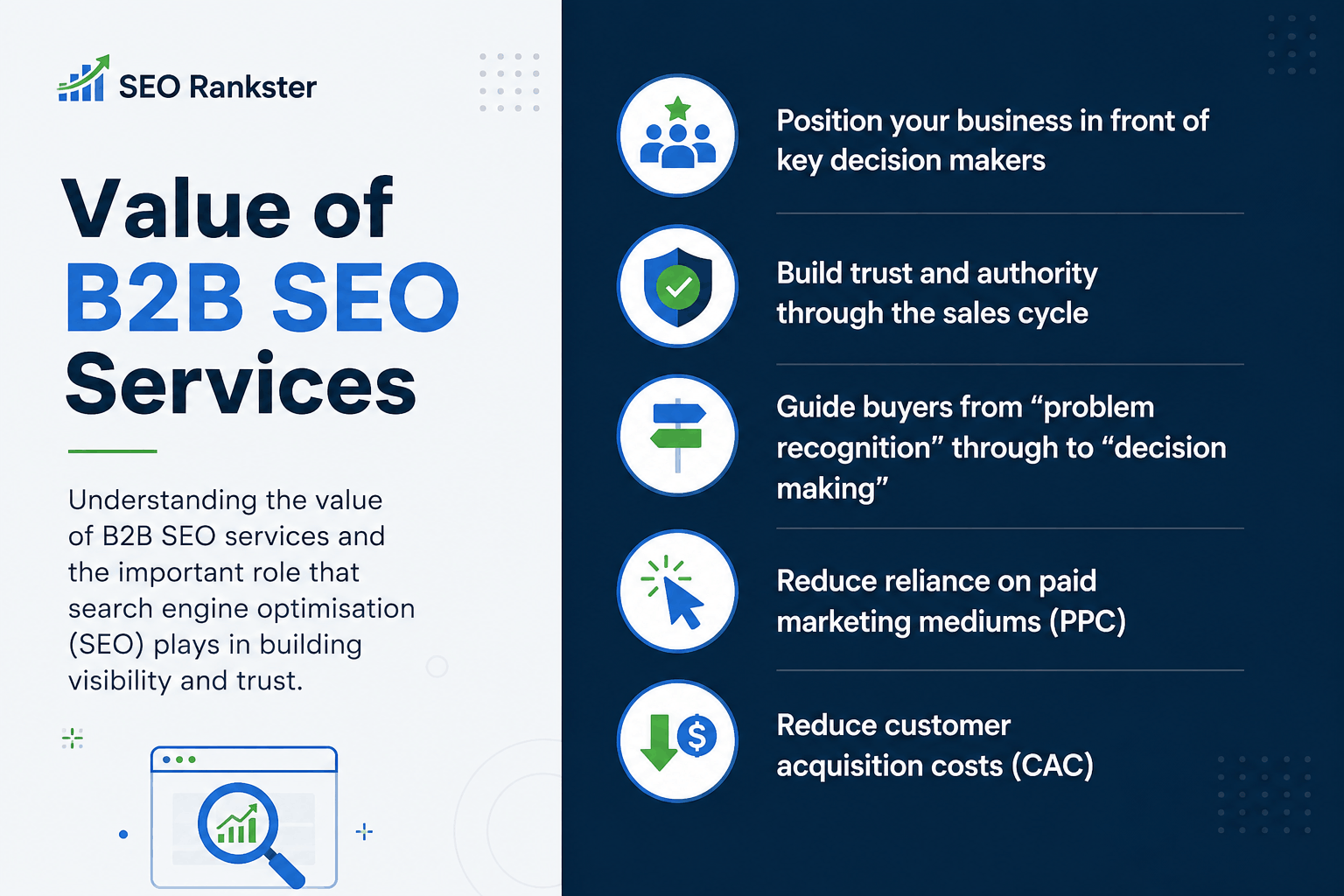
SEO Rankster maps content to where a buyer actually is, not just to where they end up.
Problem-aware
Educational guides and problem definitions bring these searches into the site.
Solution-aware
Solution guides, use cases, and comparisons help this stage evaluate options.
Vendor-aware
Service pages, pricing, case studies, and demos convert this stage.
Chasing only the bottom misses buyers still forming a shortlist. Chasing only the top brings traffic that never converts. A B2B strategy needs content at all three levels, connected to move a visitor from one to the next.
Why 200 Visitors Can Matter More Than 10,000
Ten thousand visitors from a broad, low-intent search term can look impressive in a monthly report and contribute almost nothing to the business. Two hundred visitors who searched a specific, technical, commercially relevant term, and landed on a page built to answer exactly that, can generate real enquiries. The difference is intent, not volume.
This is why SEO Rankster doesn’t optimise around vanity traffic numbers. A ranking report full of green arrows means very little if none of that visibility sits on pages that are commercially relevant to what the business actually sells. The right question isn’t how much traffic a site got. It’s how much of that traffic was searching for something the business can actually solve. That focus on relevance over volume shapes every keyword and content decision that follows, and it’s also where most B2B websites lose ground
Branded traffic only
Most of the organic traffic is people already searching the company name, because content was never built around the terms a buyer uses before they know who you are. We build pages for the problem and solution stage instead of only brand recall.
Thin service pages
Service pages describe what the business does in a few hundred generic words, written for someone who has already decided to buy. Each page should answer the questions a buyer has before they will pick up the phone.
Content disconnected from revenue
The blog publishes regularly, but that traffic never reaches a service or solution page, because topics were chosen for volume instead of how they connect to what the business sells. Content should be planned around clusters that link back to commercial pages.
Weak commercial intent
The keywords being targeted carry volume but limited buying intent, because research stopped at search volume and skipped commercial and business relevance. Keywords need qualifying by intent and customer value before they’re prioritised.
No keyword-to-page mapping
Multiple pages compete for the same term, or important terms have no page at all, because pages were added over time without a plan for how they relate. A single map should tie every commercially important keyword to one clear page.
No clear conversion path
A visitor ready to talk to sales has to hunt for a way to do it, because calls to action are generic and identical across every stage of the site. Every page should offer the next step that matches how ready that visitor actually is.
Why the same playbook doesn't apply
B2B search behaves differently from consumer search, and strategies built for one rarely work for the other. For larger organizations with complex websites, multiple business units, large content libraries, and many stakeholders, these challenges can also overlap with the requirements of Enterprise SEO.
|
|
Consumer SEO
|
B2B SEO
|
|---|---|---|
|
Search volume
|
||
|
Buying cycle
|
Often same-day
|
|
|
Decision makers
|
Usually one person
|
|
|
Customer value
|
Lower average order value
|
|
|
Language
|
Everyday terms
|
|
|
Conversion point
|
Usually one purchase action
|
This is why chasing only the highest-volume keyword in a category is often the wrong call for a B2B business. A term searched two hundred times a month by procurement managers who can actually buy the product is worth more than a term searched five thousand times a month by people who never will.
What We Actually Do
Search Intelligence
Research grounded in commercial value, not just volume: problem, solution, service, product, industry, and competitor keywords, qualified by intent.
Commercial Keyword Strategy
Every keyword mapped to a specific page and buying stage, so the site stops guessing and starts covering the right ground with the right priority.
Website Architecture
A structure that groups services, solutions, industries, and resources logically, so both visitors and search engines can find their way to the right page.
Technical SEO
Crawlability, indexation, Core Web Vitals, and structured data, fixed in the order that actually affects visibility, not a generic audit checklist.
Commercial Page Optimisation
Service, solution, product, and industry pages rebuilt around the problem they solve and the evidence that backs it up, not generic description.
Content & Topical Authority
Guides and supporting pages built around the core topics your buyers research, connected so the site earns authority instead of scattered coverage.
Digital PR & Authority
Links and mentions earned through original research, expert commentary, and relevant coverage, never through schemes.
Conversion Optimisation
Calls to action and forms matched to how ready a visitor actually is, from a guide download to a quote request.
Measurement & Iteration
Reporting built around qualified traffic and leads, not rankings alone, with honest updates on what’s working.
A Website Built the Way Buyers and Search Engines Both Need
Search engines rely on structure to understand what a site covers and how important each page is. A logical hierarchy, homepage leading to services, solutions, industries, use cases, products, resources, case studies, and comparisons, each linked to related pages, does two things at once: it helps a visitor find the specific page that answers their search, and it tells search engines how topics relate to each other.
This isn’t a case for creating as many pages as possible. A page that exists only to add another URL to the sitemap dilutes the site instead of strengthening it. Every page in the structure should exist because a real search, a real buyer question, or a real stage of the buying journey needs it.
What a strong commercial page actually contains
Service, solution, product, industry, use-case, comparison, and location pages all do commercial work, and they need more than a paragraph of description to do it.
A page that ranks and converts usually has a clear sense of the search intent behind it, names the specific problem it solves, explains the solution in plain but accurate language, backs it up with evidence rather than adjectives, links to genuinely related pages, includes something that builds trust, whether that’s specificity, a case reference, or a clear explanation of process, and ends with a call to action that matches how ready that visitor is.
A generic 500-word service page rarely competes for a commercially valuable term, not because it’s short, but because it doesn’t answer enough of what a buyer needs to know before they’ll consider reaching out. Length isn’t the goal. Completeness is.
Content That Has a Job to Do
Every piece of content on a B2B site should exist for a specific reason: to educate someone early in their research, capture a specific informational search, build authority on a subject, answer an objection a prospect would otherwise raise on a sales call, support a commercial page with context it doesn’t have room for, capture a comparison search, help a sales conversation move faster, generate a lead directly, earn a backlink, or strengthen the site’s authority on a topic. Content published without one of those jobs in mind is usually the content that never gets read after publication, and it rarely helps the pages that actually generate revenue.
Top of funnel
Educational content, industry research, problem guides, definitions, and market information bring early research into the site.
Middle of funnel
Solution guides, use cases, comparisons, implementation guides, and best practices help someone evaluate options.
Bottom of funnel
Service pages, product pages, pricing pages, alternatives, case studies, and demo pages are where the decision happens.
Building topical authority
Topical authority works the same way regardless of industry.
A cybersecurity company might build a core page on cybersecurity, supported by pages on network security, endpoint security, cloud security, identity management, threat detection, security compliance, cybersecurity software, and cybersecurity services, each linking back to the core page and to each other.
None of this works because Google rewards a site for publishing a large number of articles. It works because the coverage is genuinely useful and the pages are connected in a way that reflects how the topic actually breaks down. A site with a dozen well-connected pages on a subject usually outperforms a site with sixty unconnected ones.
The Technical Work That Makes Everything Else Possible
None of the content or commercial page work matters if search engines can’t crawl the site properly, index the right pages, or serve them quickly enough to hold a visitor’s attention. Technical SEO covers crawlability, indexation, canonicalisation, duplicate content, redirects, orphan pages, internal linking, the XML sitemap, and robots.txt, and on larger B2B sites, these issues compound quickly. A single misconfigured redirect chain or an orphaned solution page can quietly remove real commercial pages from search results for months without anyone noticing.
Core Web Vitals, page speed, and mobile experience affect both rankings and how long a visitor stays once they arrive. A service page that takes six seconds to load loses a share of visitors before they read a word of it, regardless of how well it’s written.
JavaScript-heavy websites need particular attention. If key content only renders after a script runs, and that script isn’t handled correctly, search engines may never see the page the way a visitor does. Structured data helps search engines understand what a page represents, which can influence how it’s displayed in results.
For companies operating in multiple countries, international technical setup, hreflang, country-specific architecture, matters as much as the content itself. None of this needs to become a developer’s checklist for a business owner to understand. It needs to work, and someone needs to be able to explain in plain terms what changed and why it mattered. See more on our technical SEO approach separately.
Building Authority Without Shortcuts
Authority in B2B search still comes largely from other credible sites linking to yours, and the ways to earn that legitimately are slower but durable: coverage in relevant industry publications, original research that other sites want to reference, expert commentary, involvement with industry associations, partnerships that produce genuinely useful joint content, and thought leadership that says something specific rather than restating what everyone else has already published.
What we won’t do is buy links, use private blog networks, run automated link-building software, submit a site to hundreds of low-quality directories, or pay for placement on guest post farms that exist purely to sell links. These tactics can produce short-term movement and long-term risk, and they’re easy for search engines to identify as manipulation. For a B2B company whose site represents years of credibility with actual customers, that risk usually isn’t worth whatever ranking bump it might produce.
Turning Search Into Pipeline, With Sales in the Loop
Some of the most useful keyword and content ideas never show up in a keyword tool. They come from the sales team: the questions prospects ask on every call, the objections that come up before someone will sign, the reasons deals fall through, the features buyers compare against a competitor, the implementation and pricing questions that stall a decision, and the procurement concerns that need answering before legal will even look at a contract.
Turning those conversations into content means a prospect can find the answer during their research instead of raising it for the first time on a call, and it means marketing and sales are working from the same picture of what buyers actually need to know, instead of two separate views of the same audience.
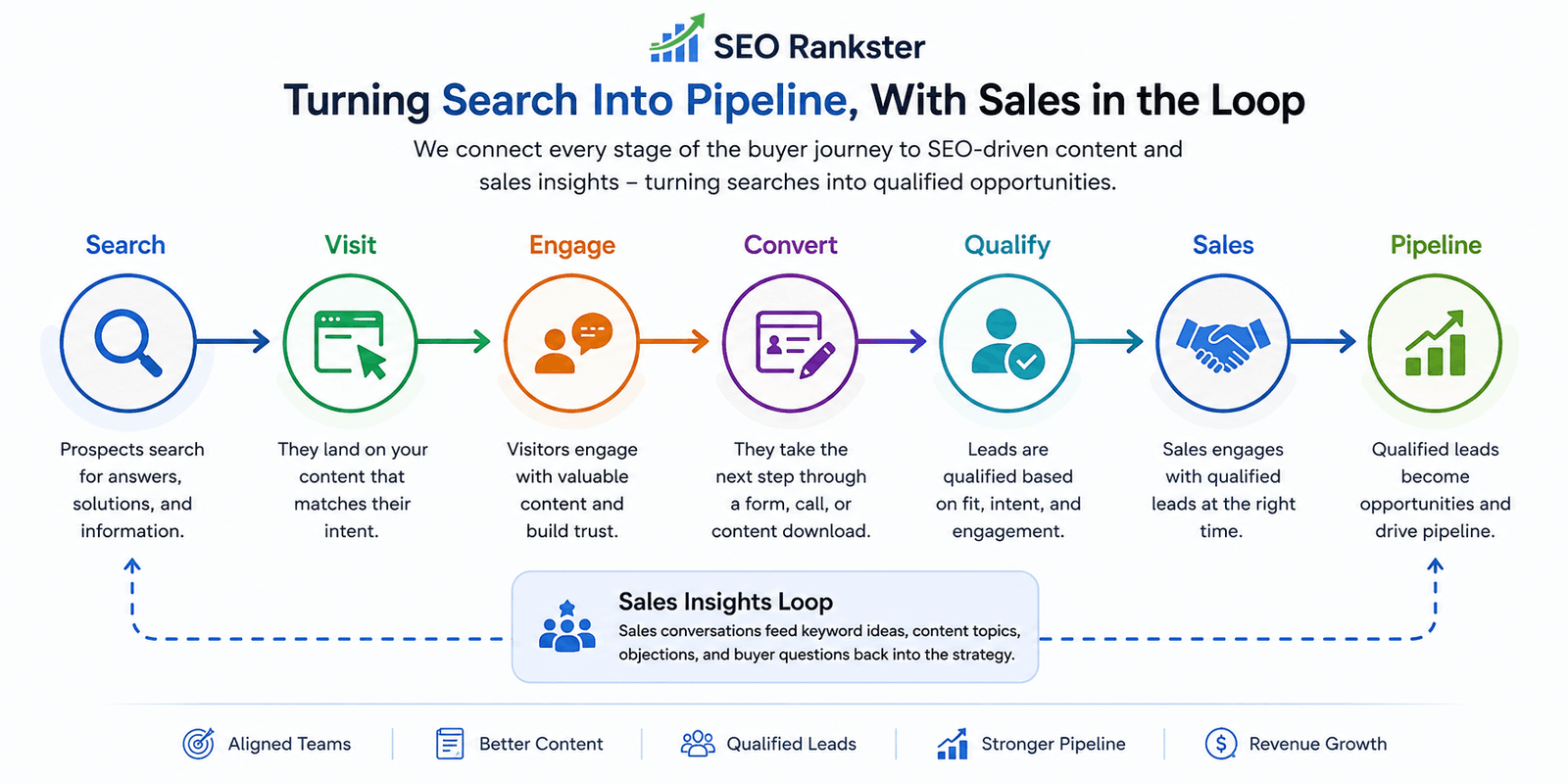
Not every visitor should be pushed toward a sales form immediately. Someone at the Problem stage who lands on a guide isn’t ready for “book a call,” and a form that asks for too much too early usually just loses them. The right next step depends on where they are: a download or a subscription for someone early in research, a case study or comparison for someone evaluating, a quote request, consultation, or demo for someone ready to act.
Tracking should follow that same path, from the initial visit, through engagement with the content, through a form or call, into a qualified lead, and where a CRM allows it, into a tracked sales opportunity. That’s the difference between organic traffic and organic pipeline.
Measuring What Actually Matters
Rankings and raw traffic are the easiest numbers to report and the least useful on their own. We track qualified organic traffic to commercially relevant pages, the split between branded and non-branded visibility, conversions, and where a CRM allows it, marketing qualified leads, sales qualified leads, and pipeline influence, pulling from Google Search Console, GA4, and whatever CRM data the business already has.
We’re honest about where that measurement runs out. Buyers research across weeks or months, across multiple sessions and sometimes multiple devices, and a meaningful share of that research never touches a form. Perfect attribution from first search to closed deal isn’t something any SEO agency can promise honestly. What we can measure, we report clearly. What we can’t, we say so.
International and multi-market SEO
Companies selling into more than one country need international SEO that reflects how each market actually searches, not one page duplicated and translated for every region.
That means researching search intent and terminology market by market, since a term that converts well in one country can mean something different, or nothing at all, in another. It means proper hreflang implementation, an architecture that supports country or region-specific pages where the business genuinely needs them, and awareness of who the regional competitors actually are, which is often a different set of companies than the competitors at home. For B2B companies with a physical office or a defined regional service area, local SEO is a related but separate consideration.
Who We Work With, and How
Strategy changes with business model. A SaaS company selling self-serve software needs a different architecture than a consulting firm selling six-figure engagements. These are the business models we work with most, not an exhaustive list.
SaaS
Self-serve and sales-assisted products competing on feature and comparison searches.
Professional Services
Long consideration cycles built on trust, proof, and referrals.
Manufacturing
Technical buyers researching specifications, capabilities, and reliability.
Technology & IT
Complex solutions sold to multiple technical and business stakeholders.
Consulting
Expertise-led sales where content demonstrates capability before a call happens.
Industrial & Distribution
Regional and national buyers researching suppliers and specifications.
Enterprise
Multiple stakeholders, procurement processes, and longer approval chains.
Business Services
Recurring service relationships sold on reliability and results.
How we work
Discover starts with understanding the business, the buying process, and where the website currently stands. Research maps search demand, competitors, and the technical condition of the site. Prioritise ranks the opportunities by commercial value, not just ease or volume. Build fixes architecture, technical issues, and the pages that need to exist. Optimise rewrites commercial pages around real search intent. Strengthen builds content and authority around the topics that matter most. Measure tracks qualified traffic, leads, and where possible, pipeline. Improve adjusts the plan based on what the data actually shows.
Why SEO Rankster
Strategic SEO built around commercial intent rather than rankings for their own sake.
Content written by people who understand the subject, not generated to hit a word count. Technical work scoped to what a B2B site actually needs. Reporting that says plainly what’s working and what isn’t. It also means we won’t guarantee a ranking, pad a report with vanity metrics, recommend work that doesn’t move the business forward, or use link-building tactics that put years of domain credibility at risk for a short-term gain. Every recommendation gets weighed against whether it moves qualified traffic, leads, or pipeline, not whether it looks good in a monthly deck.
B2B SEO Questions, Answered Directly
What are B2B SEO services?
B2B SEO services are search engine optimisation built around how businesses research and buy from other businesses: longer buying cycles, multiple decision-makers, and content that needs to work at every stage from first research to final approval, not just the point of purchase.
How is B2B SEO different from B2C SEO?
Consumer SEO usually optimises for higher search volume and faster decisions. B2B SEO often targets lower-volume, higher-value terms searched by fewer people over a longer period, with multiple stakeholders involved before a purchase happens.
Why do B2B companies need SEO?
Because most B2B buyers research online before ever contacting a company directly. If a business only ranks for its own name, it’s invisible during the research and shortlisting stages where competitors are already being found and considered.
How can B2B SEO generate leads?
By building content and pages that match what buyers search at each stage, then giving them a clear next step, whether that’s downloading a guide, viewing a case study, or requesting a demo, so organic visits turn into tracked, qualified leads.
What keywords should a B2B company target?
A mix across the funnel: problem-stage searches that bring in early research traffic, solution-stage searches from people evaluating options, and vendor-stage searches from people ready to compare and buy, weighted toward the terms with real commercial and business relevance.
Should B2B companies focus on high-volume keywords?
Not exclusively. A lower-volume term searched by the right buyer can be worth more than a high-volume term searched mostly by people who will never purchase. Volume matters, but intent and buyer relevance matter more.
How long does B2B SEO take?
Early technical and architectural improvements can show up within the first couple of months. Meaningful growth in qualified organic traffic and commercial keyword visibility typically takes three to six months, with authority and pipeline contribution building over six to twelve months and beyond.
How much do B2B SEO services cost?
It depends on the size of the website, the number of services, products, and industries involved, technical complexity, and how much content and authority work is needed. We don’t quote a price without reviewing the site first, since a generic number wouldn’t reflect the actual work involved.
Can SEO generate enterprise leads?
It can bring enterprise buyers into the research and shortlisting process, particularly through content that speaks to specific use cases, technical requirements, and comparison decisions. It rarely closes an enterprise deal on its own, since those usually involve a direct sales process alongside it.
What is the difference between B2B SEO and Google Ads?
SEO builds visibility that compounds over time without a per-click cost, but takes longer to show results. Google Ads is immediate and controllable but stops the moment the budget does. Most B2B companies benefit from using both, often at different stages of a campaign.
How does SEO Rankster approach B2B SEO?
By mapping content to the buying journey, qualifying keywords by commercial value rather than volume alone, building an architecture that supports service, solution, and industry pages properly, and measuring results against qualified traffic and leads rather than rankings alone.
Your Buyers Are Searching. Make Sure They Find You.
A free assessment looks at keyword opportunities, competitor visibility, technical SEO, commercial page performance, content gaps, and where your authority currently stands, so you know exactly where the opportunity is before committing to anything.